

The “Sunday Scaries” Are Changing — Why Tuesday Is Now the Most Exhausting Day
For decades, the collective anxiety of the workforce had a specific name: The “Sunday Scaries.” It was that pit in your stomach at 7:00 PM on a Sunday, dreading the alarm clock.
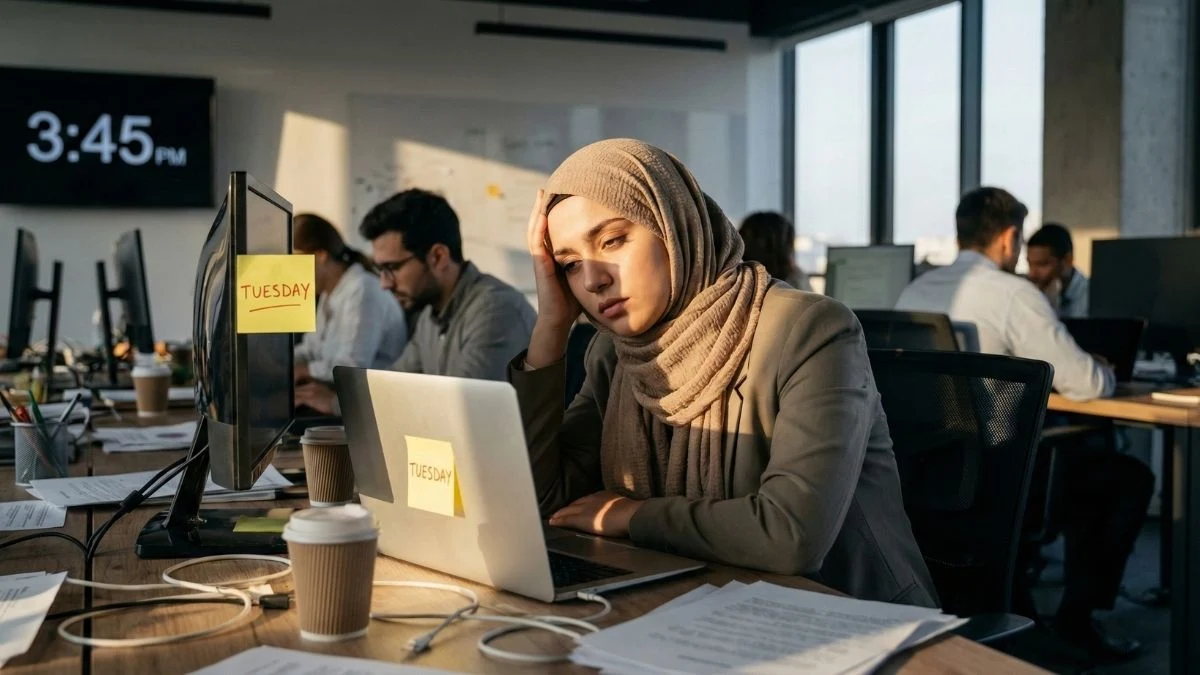
But if you are a modern woman working a hybrid schedule, you may have noticed a shift. Sunday feels… okay. Monday feels manageable. But then, Tuesday hits.
According to our deep-dive analysis of workplace sentiment and behavioral data, the epicenter of stress has moved. We are no longer dreading the start of the week; we are crashing in the middle of it.
Welcome to the era of the “Tuesday Slump.” Here is the science behind why you feel like you’ve run a marathon by Tuesday at 2:00 PM, and the somatic tools to reclaim your energy.
The Death of Monday & The Rise of the “Tuesday Tsunami”
Why the shift? The answer lies in the “hybrid” trap.
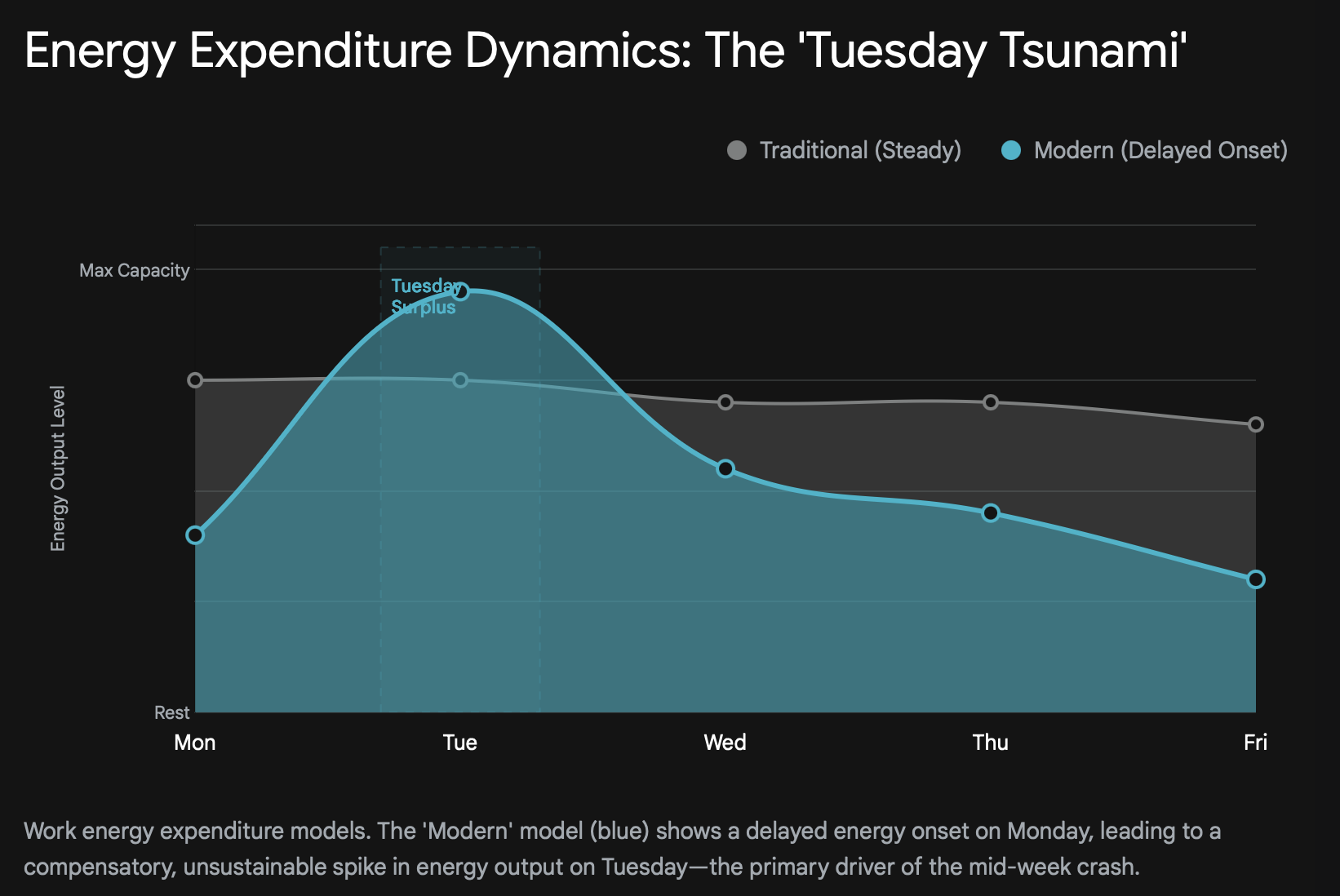
In the post-2020 world, Monday has quietly become a “soft launch” for the week. Known culturally as “Bare Minimum Mondays,” many workers use this day for remote work, admin tasks, and easing in from the weekend. You might work from home in sweatpants, answering emails at your own pace.
But this comfort comes at a cost. Because Monday is “soft,” Tuesday must be “hard.”
Data from corporate real estate firms like Korn Ferry confirms that Tuesday is now the highest office occupancy day globally. This gives rise to a phenomenon we call the “Tuesday Tsunami.” You aren’t just starting work; you are being hit with:
- The physical commute.
- The sensory overload of a full office.
- The pressure to “perform” socially.
- A backlog of “real work” that was pushed off Monday.
The Science: Decision Fatigue Hitting a Wall
You aren’t imagining the brain fog. There is a neurobiological reason why you hit a wall specifically between 2:00 PM and 4:00 PM on Tuesday.
It is called Accumulated Decision Fatigue.
On Monday, you spend your cognitive energy planning (making to-do lists, sorting emails). By Tuesday morning, you have to execute. Your brain is sprinting. Research indicates that decision fatigue accumulates linearly. By Tuesday afternoon, your Prefrontal Cortex—the part of your brain responsible for focus and emotional regulation—is simply out of fuel.
A study on workplace health even found that Tuesday is the day of “peak sensitivity” for adverse health events, showing spikes in blood pressure that exceed those found on Mondays.
Why Women Feel the “Tuesday Crunch” More
This phenomenon is deeply gendered. For working women, the Tuesday Slump is often a collision between corporate demands and biological reality.
1. The “Second Shift” Overload
For many women, the “Soft Monday” isn’t actually rest; it is a day to catch up on domestic labor (laundry, meal prep, scheduling doctor appointments). This means you enter Tuesday already depleted from a full day of “invisible work.”
2. Infradian Rhythm Mismatch
Unlike men, whose hormones reset every 24 hours, women operate on a 28-day cycle. If a high-stakes, high-sensory “Office Tuesday” falls during your Luteal Phase (the week before your period), you are fighting your own biology.
During this phase, your body naturally wants to slow down and turn inward. Forcing yourself to mask, socialize, and commute under harsh fluorescent lighting triggers a cortisol spike that leaves you feeling “wired but tired” by the evening.
How to Survive: 3 Somatic Resets for Tuesday Afternoon
Standard advice like “take a nap” isn’t helpful when you are in an open-plan office. Instead, we need “Stealth Somatic Interventions”—tiny biological hacks that signal safety to your nervous system without anyone noticing.
1. The “Physiological Sigh” (The 2 PM Reset)
When you feel the panic rising, your CO2 levels are likely too high. Use this breathing pattern validated by neurobiology labs:
- Take a sharp inhale through your nose.
- Take a second, tiny inhale on top (to pop open the air sacs in your lungs).
- Exhale slowly and fully through your mouth.
- Repeat 3 times. This manually hits the “brake” on your heart rate.
2. The “Tongue Drop”
Check your jaw right now. Is your tongue pressed against the roof of your mouth? This is a stress response connected to the Vagus Nerve.
- The Fix: Consciously drop your tongue to the floor of your mouth and let it widen. This simple movement sends a signal to your brainstem that you are not under attack.
3. Non-Sleep Deep Rest (NSDR)
If you can escape to your car or a quiet corner for 10 minutes, try NSDR. Unlike a nap, which can leave you groggy, this guided relaxation resets your dopamine levels and clears the “sleepiness chemical” (adenosine) from your brain. It is the most efficient way to recover from the sensory overload of a busy office.
Conclusion: Redefine Your Rhythm
If Tuesday feels like the hardest day of the week, know that it is not a personal failure. It is a structural flaw of the modern hybrid workweek. You are trying to sprint a marathon.
By recognizing the Tuesday Slump for what it is—a sensory and cognitive bottleneck—you can stop blaming yourself for “being lazy” and start giving your body the micro-breaks it needs to survive the surge.
Methodology & Data Sources
This report is grounded in a comparative analysis of anonymized workplace sentiment discussions (via communities such as r/workingmoms and r/productivity), corporate occupancy and attendance data, and peer-reviewed neurobiological research on decision fatigue published between 2024 and 2026. All scientific papers, expert protocols, and trend reports referenced are hyperlinked directly within the text for editorial transparency.