

The Viral Coffee Filter Plant Hack: Stop Losing Potting Soil Forever
Picture this: you have just spent a beautifully slow Saturday afternoon repotting your favorite indoor plants. Your hands are covered in dirt, your countertops are wiped down, and your indoor jungle looks absolutely thriving. You give your freshly potted Monstera a generous drink of water, anticipating that satisfying drip into the saucer below. But instead of clear water, a muddy brown river escapes from the drainage holes, carrying your expensive potting soil with it, staining your saucer, and leaving a mess on your pristine floor.
If you are nodding your head right now, you are definitely not alone. It is a shared, frustrating struggle among plant enthusiasts everywhere. We all know that drainage holes are non-negotiable for plant health, but dealing with the constant soil erosion and muddy runoff can feel like a never-ending battle.
Fortunately, there is a remarkably simple, budget-friendly solution hiding right in your kitchen cabinets: the humble paper coffee filter. Grab your favorite cup of coffee or tea, settle in, and let us explore exactly why this clever little trick is taking the indoor gardening world by storm, and how you can use it to build a cleaner, healthier environment for your plants.
The Root of the Problem: Why We Lose Soil
To understand why the coffee filter method is so brilliant, we first need to talk about why we lose soil in the first place. When you buy a high-quality potting mix, it is usually a blend of peat moss, coco coir, perlite, and various organic materials. These components are relatively lightweight.
When you water your plant, gravity pulls the water downward through the soil profile. As the water travels, it picks up the finest particles of dirt and organic matter. When the water reaches the drainage hole at the bottom of the pot, those fine particles are carried right out along with it. Over time, this does not just cause a mess on your floors or windowsills; it actually depletes the soil volume inside the pot, exposing delicate roots and reducing the amount of nutrients available to your plant.
You might be thinking, “Well, why not just use pots without drainage holes?” Any seasoned gardener will immediately caution against this. Without a way for excess water to escape, water pools at the bottom of the pot, suffocating the roots and leading to a fatal condition known as root rot. Drainage is absolutely essential; we just need a way to filter the water as it exits.
The Gravel Myth: Why You Should Stop Putting Rocks at the Bottom
For decades, well-meaning garden center employees and old gardening books advised placing a layer of gravel or small rocks at the bottom of pots to “improve drainage” and prevent soil from falling out. However, modern botanical science has entirely debunked this practice.
Putting rocks at the bottom of your planters does not improve drainage; it actually hinders it. This practice forms a phenomenon known as a “perched water table.” Water is heavy, but it is also cohesive (it likes to stick together) and adhesive (it likes to stick to other things, like soil particles). Because of these physical properties, water will not easily move from a fine-textured material (like potting soil) into a coarse-textured material (like gravel) until the fine material is completely saturated.
By adding a layer of rocks, you are essentially moving the soggy, saturated zone of soil higher up in the pot, bringing it dangerously close to your plant’s sensitive root system. Furthermore, the rocks take up valuable space that your plant’s roots could otherwise utilize to grow and stabilize. We need a solution that keeps the soil in the pot without taking up space or altering the hydrology of the soil.
Enter the coffee filter.
How the Coffee Filter Hack Works
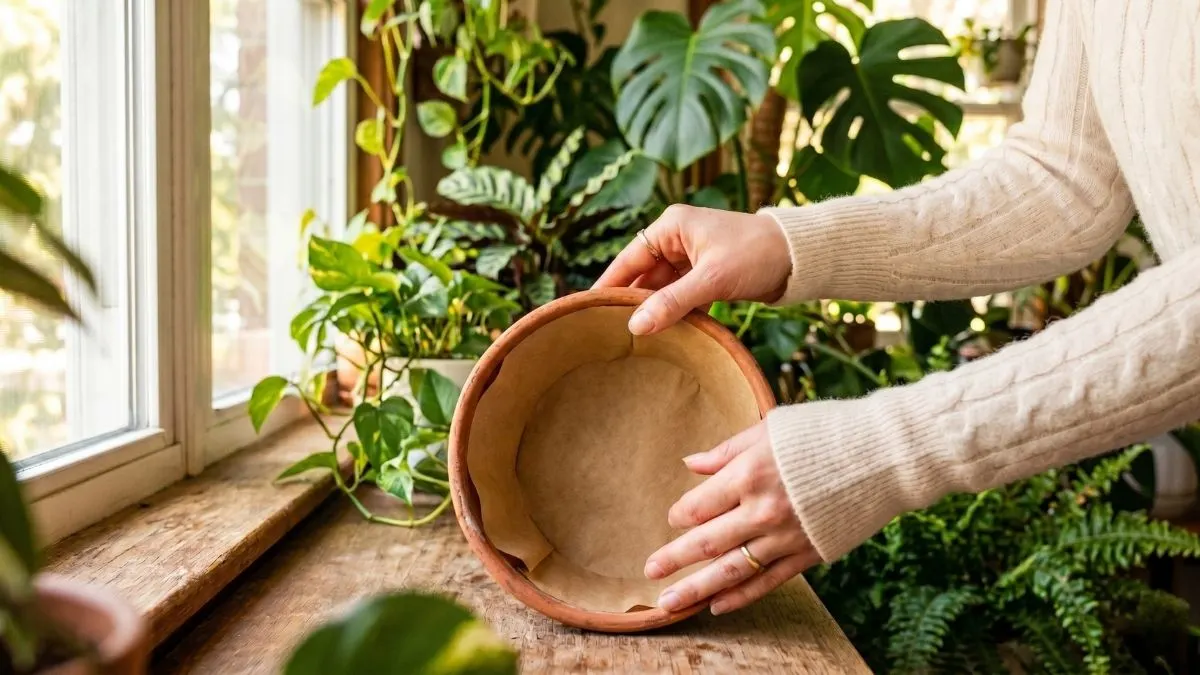
A coffee filter is explicitly engineered to perform one specific job: to let liquid flow through freely while trapping fine particles. When you place a coffee filter over the drainage hole inside your planter, it acts as a highly effective, permeable barrier.
When you water your plant, the excess moisture easily passes through the thin, porous paper, dripping out cleanly into your saucer. The fine particles of peat moss, dirt, and perlite remain securely trapped inside the pot where they belong. The result? Crystal clear drainage water, pristine floors, and a root system that maintains its full volume of soil.
Real Talk from the Plant Community
If you spend any time reading through community forums, you will see that this is not just a passing trend. On active platforms like Reddit’s r/houseplants, users frequently share their success stories regarding this exact method.
Many users highlight the relief of finally tossing out the heavy gravel they used to hoard for potting. One highly upvoted discussion recently focused on how the coffee filter hack completely eliminated the muddy rings that used to stain their white ceramic saucers. Another user pointed out an unexpected benefit: placing a coffee filter at the bottom also helps deter pests, like fungus gnats or slugs (if your plants spend summers outdoors), from entering the pot through the bottom drainage holes. The community consensus is clear: it is a practical, inexpensive, and scientifically sound approach to plant care.
Step-by-Step: How to Implement the Coffee Filter Hack
Ready to try it yourself? Next time you are repotting a plant, follow these simple steps to ensure you do it correctly.
Step 1: Gather Your Supplies
You will need your clean planter (with at least one drainage hole), your preferred potting mix, your plant, and, of course, a paper coffee filter. Standard basket-style or cone-style filters both work perfectly. If you have the choice, opt for unbleached (brown) filters, as they are slightly more natural, but standard white bleached filters will not harm your plants.
Step 2: Position the Filter
Take one dry coffee filter and place it flat against the bottom of the empty pot, directly over the drainage hole. If you are using a very large pot with multiple drainage holes, you can use two or three filters slightly overlapping each other to cover the entire bottom surface.
Step 3: Add the Base Soil
Gently add a scoop or two of your potting mix directly on top of the coffee filter. Press it down lightly. This initial layer acts as an anchor, holding the thin paper securely in place so it does not shift around when you place the plant inside.
Step 4: Position and Fill
Place your plant into the pot, ensuring the root ball is centered and sits at the correct height. Fill the surrounding space with the rest of your potting mix, tapping the sides of the pot gently to help the soil settle into any air pockets.
Step 5: The First Watering
Give your plant a thorough watering. The very first time you water, you might see a tiny bit of cloudiness as the paper settles, but within seconds, you should notice significantly clearer water flowing into your drainage tray. Success!
Beyond Coffee Filters: Alternatives You Already Have
What if you use a French press and do not actually keep paper filters in your pantry? Do not worry; you can still achieve the exact same results by looking for alternative materials around your home that serve the same purpose.
- Drywall Mesh Tape: A favorite among professional landscapers. It is slightly sticky, so you can place a small square right over the hole, and it stays put while you add dirt.
- Old Window Screens: If you have scraps of fiberglass or aluminum window screening lying in the garage, cut them into small squares. They are durable, completely water-permeable, and will never break down.
- Newspaper or Paper Towels: In a pinch, a folded piece of newspaper or a sturdy paper towel will work. They break down much faster than a standard coffee filter, but they will hold the soil long enough for the roots to establish themselves.
Frequently Asked Questions (FAQ)
To make sure you have all the information you need, let us address a few common questions that pop up regarding this method.
Will the paper filter decompose over time? Yes, it will. Paper is an organic material, and the natural moisture and microbes in the soil will eventually break it down. However, this is actually a good thing! By the time the paper decomposes (usually taking several months to a year, depending on the moisture level), your plant’s root system will have expanded and established a strong, interconnected network. This root structure will naturally hold the soil together, meaning the filter is no longer necessary by the time it vanishes.
Does the wet paper cause mold or block airflow? No, it does not. Coffee filters are specifically designed to be breathable and highly permeable. They will not trap excess moisture or prevent necessary oxygen from reaching the bottom of the root system. As long as you are using a well-draining soil mix and not overwatering your plant, the paper filter will not introduce any mold issues.
Can I use this for outdoor potted plants? Absolutely. This method is incredibly beneficial for outdoor container gardens, patio pots, and hanging baskets. Because outdoor plants often receive heavy rainfalls, they are even more prone to losing soil through drainage holes. A filter will keep your patio clean and your soil intact during heavy summer storms.
A Cleaner, Happier Indoor Jungle
Taking care of indoor plants should be a relaxing, rewarding hobby, not a source of constant cleanup. By simply borrowing a coffee filter from your morning routine, you can completely eliminate the mess of muddy runoff, preserve your expensive potting soil, and provide your plants with the ideal environment they need to flourish.
It is a beautiful example of how the most practical solutions are often the simplest ones. So, the next time you prepare to repot that rapidly growing Pothos or that stunning new Philodendron, remember to grab a coffee filter first. Your plants—and your freshly cleaned floors—will undoubtedly thank you for it.