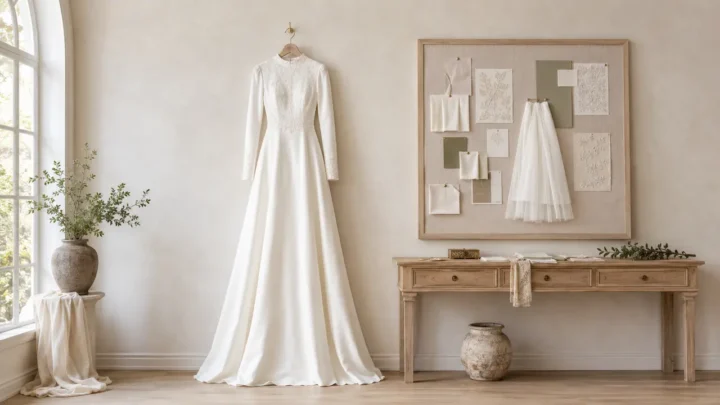
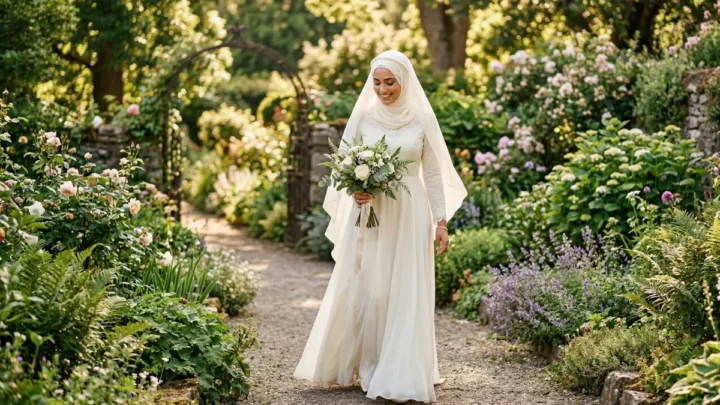
Lace is having a very visible bridal moment in 2026, but many runway versions depend on transparency, nude mesh or a close-to-the-body fit. A modest bride does not have to borrow those parts of the trend to keep the beauty of the fabric.
The detail worth watching instead is dimensional, tone-on-tone lace placed over a fully opaque base—especially when the lace finishes in a defined scalloped edge at the high neckline, cuff, covered-button back or veil. The richness comes from thread, relief, layering and shadow rather than from skin showing through the pattern.
That distinction matters. Vogue’s 2026 bridal trend report describes lace as one of the season’s strongest directions and notes designers using it in layered, textural and increasingly varied ways. Who What Wear’s Spring 2026 bridal coverage also points to high necklines, tactile fabrics and more dramatic volume. Those runway signals can be translated into a much more covered wardrobe without compromising the bride’s values.
What makes this lace detail feel current in 2026?
The freshest lace gowns are not relying on one flat sheet of lace from shoulder to hem. Instead, the eye sees changes in scale and depth: a denser motif at the collar, a crisp scallop at the wrist, raised appliqué over the bodice, a line of fabric-covered buttons, then a quieter lace field across a fuller skirt.
For modest bridalwear, the most useful version keeps the foundation completely opaque and lets the lace sit on top as ornament and texture. The underlayer should be close enough in color that the gown reads as one refined surface rather than “lace over a skin-colored panel.”

A softly structured A-line or ball-gown shape also helps. The fabric can fall away from the body rather than tracing the chest, waist and hips. That is especially important in photographs, where a dress that looked loose while standing still can appear much more fitted from a side angle or while walking.
The elegant formula: opaque base + raised lace + a defined edge
Think of the lace as the finishing architecture of the gown rather than a substitute for fabric. A matte ivory or soft-white lining gives full coverage first. Lace then adds surface interest through corded outlines, embroidery, small floral appliqués or a scalloped border.
The strongest details are often small enough to notice only after the silhouette has already made its impression. A clean high collar can finish with a narrow lace edge. A long sleeve can end in a shaped cuff with covered buttons. The back can use a continuous opaque panel with a button line instead of an illusion insert. A veil can echo the same lace family without matching every motif exactly.
Myth: lace needs skin contrast to show its pattern
Reality: good lace can read beautifully against an opaque tonal base. The contrast comes from thread thickness, relief, matte-versus-slight-sheen texture, motif density and the shadow formed by raised embroidery. If the pattern disappears completely once it is lined, the problem may be the lace choice or the lining tone—not the absence of transparency.

Where this detail works best on a modest gown
At the neckline: a high opaque neckline gains definition when the lace becomes denser near the collar or ends in a narrow scallop. The collar should sit comfortably with the hijab arrangement and should not rely on transparent mesh at the throat.
At the cuffs: scalloped lace, small covered buttons and a softly shaped sleeve opening give the wrist a finished look. Check that the sleeve remains properly covered when the arm is raised, not only when the hand rests at the side.
At the back: fabric-covered buttons are particularly effective when they run over an opaque back panel. They provide a classic bridal focal point without a cutout or illusion section.
At the veil edge: a restrained lace border can tie the look together while keeping the hijab itself calm. When the gown is already heavily textured, a narrow edge usually looks more balanced than another full field of dense embroidery.
The Women’s Alphabet Three-Distance Lace Test
A lace swatch can look perfect in a close-up phone photo and still behave very differently on a finished dress. Before approving the fabric combination, check it at three distances.
- Close-up: inspect the threadwork, appliqué edges and lining. No transparent gap should reveal skin beneath the lace.
- Two steps away: look for a clear overall pattern. The gown should read as textured and refined rather than visually busy or patchy.
- Backlit: stand near a bright window or strong light source. The lining should remain genuinely opaque, and the outline of the body should not suddenly become more visible through thin fabric.
This is not an industry rule; it is a practical Women’s Alphabet fitting tool. The goal is to judge the same fabric the way it will actually be seen: close in conversation, across a room and under unforgiving light.
Try This at the Fitting
Bring the actual lining and lace together, not separate swatches. Stand facing a window, turn sideways, sit, raise both arms and take one normal phone photo without a beauty filter. If the lining becomes see-through, the bodice pulls across the chest, or the sleeve reveals the wrist when moving, adjust the construction before approving the dress.

What to ask the dressmaker before the final fitting
Start with the foundation rather than the embellishment. Ask what fabric sits directly beneath the lace and whether the bodice, sleeves and back use the same opacity level. A sleeve can look covered in the showroom yet become translucent under daylight if its lining is thinner than the body of the dress.
Then ask about ease. The finished gown should not depend on stretch to fit the torso. There should be enough room through the chest and waist for the fabric to fall rather than cling, while the shoulder and sleeve construction still looks intentional.
Check the button placket from the back and side. Decorative covered buttons should sit over a secure closure and opaque fabric; they should not pull open between button points. If the veil has a lace edge, bring it to the fitting so the border can be checked beside the gown rather than guessed from a photograph.
If the dress is still at the inspiration stage, the existing Women’s Alphabet guide to hijab-friendly bridal dress directions for 2026 can help narrow the silhouette. The modest bridal mood-board guide is useful for organizing references, but this article serves a different job: testing one lace construction detail in the real conditions of a fitting.
Details to skip, even when the lace itself is beautiful
A beautiful motif does not make an unsuitable construction modest. Skip nude illusion mesh used to imitate bare skin, unlined lace across the chest or back, transparent sleeves, body-tracing stretch lace and fitted shapes that clearly describe the chest, waist or hips.
Also be cautious when a cape, bolero or veil is being used to hide a revealing base dress. A removable layer can be an elegant detail, but the underlying gown should already meet the coverage and fit requirements that matter to the bride.
The 2026 takeaway
The most useful part of the 2026 lace revival is not transparency. It is the renewed attention to texture, craft and small finishing details. A fully lined gown can take the same visual richness and express it through raised appliqué, scalloped cuffs, covered buttons, a defined high neckline and a lace-edged veil.
When the foundation is opaque and the silhouette remains gracefully loose, lace does not need skin underneath it to feel light or refined. The detail can stay romantic, current and unmistakably bridal while modesty remains part of the dress from the first layer—not an alteration added at the end.
A Note from Women’s Alphabet
For Muslim brides, modesty should be built into the gown from the first layer. The finished dress should remain fully opaque, provide proper coverage, and fall loosely enough that the shape of the chest, waist and hips is not defined. Check the gown in daylight and while sitting, walking and raising the arms; if the fabric becomes transparent, pulls tightly across the body or exposes an area that should remain covered, have it adjusted before the wedding.