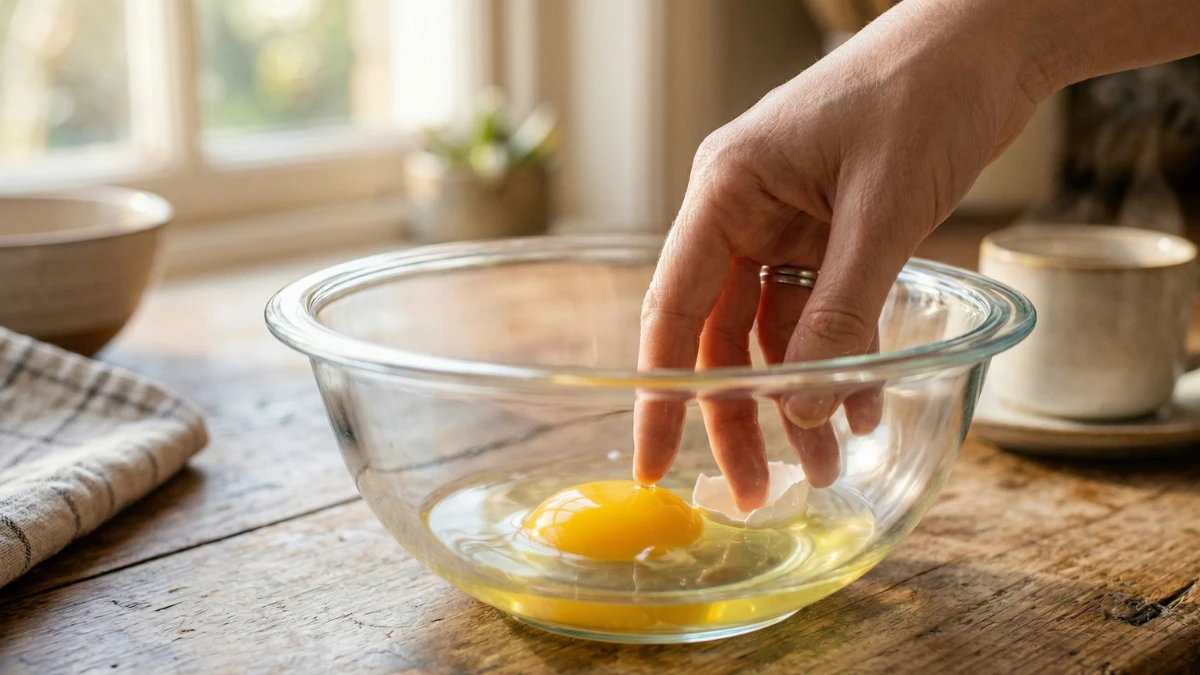
We have all been there. You are whipping up a delicious weekend omelet, a batch of rich brownies, or just a simple sunny-side-up breakfast. You gently tap the egg, pull the halves apart, and—snap! A tiny, jagged piece of eggshell dives straight into your mixing bowl.
If we are being completely honest, the very first instinct is to dive right in after it. But the moment a dry finger gets close, the eggshell seemingly develops a mind of its own, slipping and sliding away through the egg white like a tiny, evasive submarine. You try a spoon, but the clear, viscous egg white just pushes the fragment further away. It is enough to test anyone’s patience before 8:00 AM.
But do not worry. Today, we are looking at a life-changing kitchen trick that is going to save time, frustration, and the unpleasant surprise of a crunchy bite in your otherwise perfect baked goods. It is known as the “wet fingertip” hack, and it works absolute wonders. No special tools, no stress, and definitely no ruined breakfasts.
Why Do Eggshells Run Away From Us?
Before getting into the solution, it is important to understand the problem. Why is it so incredibly difficult to fish a piece of shell out of a raw egg? It feels entirely personal, but it all comes down to basic physics and fluid dynamics.
Raw egg whites (albumen) are highly viscous fluids. When you push a dry finger into the bowl, you are not just pushing the egg; you are pushing the fluid around the shell. Because the shell fragment is exceptionally light, the displacement of the thick egg white carries the shell away from your finger. To make matters worse, the proteins in the egg white stick stubbornly to dry skin, forming a thick barrier that prevents you from actually making contact with the shell fragment.
It is a classic case of high surface tension working against you. The harder you chase it, the faster it swims away, turning a simple baking step into a tedious chore.
Enter the Wet Fingertip Hack
Here is where the brilliance of simple science comes to the rescue. The solution to catching that rogue shell is water. Yes, just plain, ordinary tap water.
Here is exactly how to execute this trick for flawless results every single time:
- Spot the Shell: Locate the rogue piece of shell in your bowl. Take a second to let the egg white settle so you have a clear target.
- Wet Your Finger: Run your index finger under cold or room-temperature tap water. You want it damp, not dripping wet.
- Go in for the Catch: Gently press your wet fingertip directly onto the eggshell piece.
- Lift or Slide: The shell will immediately stick to your wet finger. You can either lift it straight out or, for larger pieces, slide it up the side of the bowl.
Why does this work so perfectly? When your finger is wet, the water breaks the surface tension and forms a microscopic bridge between your skin and the shell. The egg white cannot adhere to the film of water on your finger, which means you bypass the viscous resistance entirely. The shell clings to the moisture on your finger, allowing you to easily extract it. It is pure, practical science in action!
What the Cooking Community is Saying
When researching the best kitchen methods, it is always great to see what real home cooks and professionals are experiencing. The culinary community on Reddit is a treasure trove of tested advice and real-world trials.
In threads across r/Cooking and r/AskCulinary, the wet fingertip method is frequently praised as the ultimate savior. One user in an r/AskCulinary discussion noted, “With a wet finger, the egg shell won’t ‘run away from you’ like it normally does.” Another home cook perfectly summarized the collective relief, stating that anyone who tries this will never go back to spending minutes chasing fragments with utensils. The consensus across these communities is clear: simplicity almost always wins.
Of course, the internet loves a debate. Another popular method you will often see recommended in communities like r/lifehacks is the “shell-to-shell” trick, where you use a larger half of the broken eggshell to scoop out the tiny fragment. The theory shared by some users is that the sharp edge of the shell cuts through the egg white’s viscosity better than a blunt finger.
However, many users and food writers have rigorously tested both methods side-by-side. The verdict? While the shell-to-shell method can work as a makeshift scoop, it often takes several attempts and risks introducing more tiny, brittle fragments into your bowl if the fragile edge chips. The wet fingertip method consistently wins out for speed, cleanliness, and reliability.
Why Do Eggshells Break So Easily Sometimes?
Have you ever noticed that some eggshells are incredibly tough, while others seem to shatter just by looking at them? The structural integrity of an eggshell is a fascinating subject and depends on several factors.
First, the age of the hen plays a significant role. Younger hens tend to lay eggs with thicker, harder shells, while older flocks produce eggs with thinner shells. Second, the diet of the chicken is absolutely critical. A diet rich in calcium and vitamin D yields robust shells. If you are buying local, farm-fresh eggs, you might notice they require a firmer tap to crack compared to mass-produced supermarket eggs.
Finally, the freshness of the egg itself matters. As an egg ages in the refrigerator, moisture evaporates through the thousands of microscopic pores in the shell, causing the inner membrane to weaken. When this membrane loses its elasticity, the shell is much more prone to splintering into those tiny, frustrating fragments. Understanding these variables helps explain why some breakfasts are seamless and others turn into a rescue mission.
Pro Tips for Preventing Broken Shells
While knowing how to easily extract a shell is essential, preventing the break in the first place is even better. Here are a few expert tips to keep your cracking technique flawless:
- Crack on a Flat Surface: This is a golden rule shared by professional chefs. Instead of cracking an egg on the sharp edge of a bowl or pan, tap it firmly on a flat, clean countertop. Sharp edges drive tiny shards of shell inward, piercing the membrane and sending them into your egg. A flat surface shatters the shell outward, keeping the inner membrane intact and holding the shards safely together.
- Use the Ramekin Method: If you are baking a cake or making a large scramble, never crack eggs directly into the main mixing bowl of dry ingredients. Crack them one by one into a small separate bowl or ramekin first. This way, if a bad egg or a sneaky piece of shell gets through, it is isolated and easy to manage, saving your entire batch of expensive ingredients.
- Temperature Matters: Older eggs tend to have thinner, more brittle shells and weaker inner membranes. If you are using eggs that have been in the fridge for a long time, handle them with an extra layer of gentleness.
A Quick Note on Food Safety
Whenever we talk about handling raw eggs, it is absolutely crucial to mention food hygiene. While the wet fingertip method is incredibly effective, it does require touching raw egg whites.
Whenever the topic of handling raw ingredients comes up in communities like r/foodsafety, members are quick to remind everyone about basic kitchen hygiene. It is a well-known culinary fact that raw eggs can carry bacteria like Salmonella, which can cause foodborne illness. While the risk of a single egg being contaminated is statistically low, home cooks and professionals alike agree that taking basic precautions is always the smartest move in the kitchen.
Always thoroughly wash hands with warm water and soap before wetting a finger to retrieve the shell, and immediately wash them again after handling the raw egg. Never wipe raw-egg-covered hands on a shared kitchen towel, as this can easily spread bacteria to other surfaces. Keep the workspace clean, and you can enjoy breakfast with total peace of mind.
Final Thoughts
The kitchen should be a place of joy, comforting aromas, and delicious results—not a battleground against tiny fragments of calcium carbonate. The wet fingertip trick is one of those wonderfully simple, zero-cost solutions that instantly elevates the daily cooking routine.
It strips away the frustration of ruined batters and crunchy omelets, replacing it with a smooth, effortless process. The next time you are making a weekend brunch or whipping up a quick weeknight dinner and a rogue shell tries to ruin the day, remember this simple trick. Just add a drop of water, and you are immediately back in control.
This little piece of culinary wisdom proves that sometimes the best solutions do not require expensive gadgets or complicated techniques; they just require a tiny bit of practical science. Happy cooking, and may all your future eggs crack perfectly!