

The “Half-Scoop” Detergent Hack: What Appliance Techs Actually Recommend
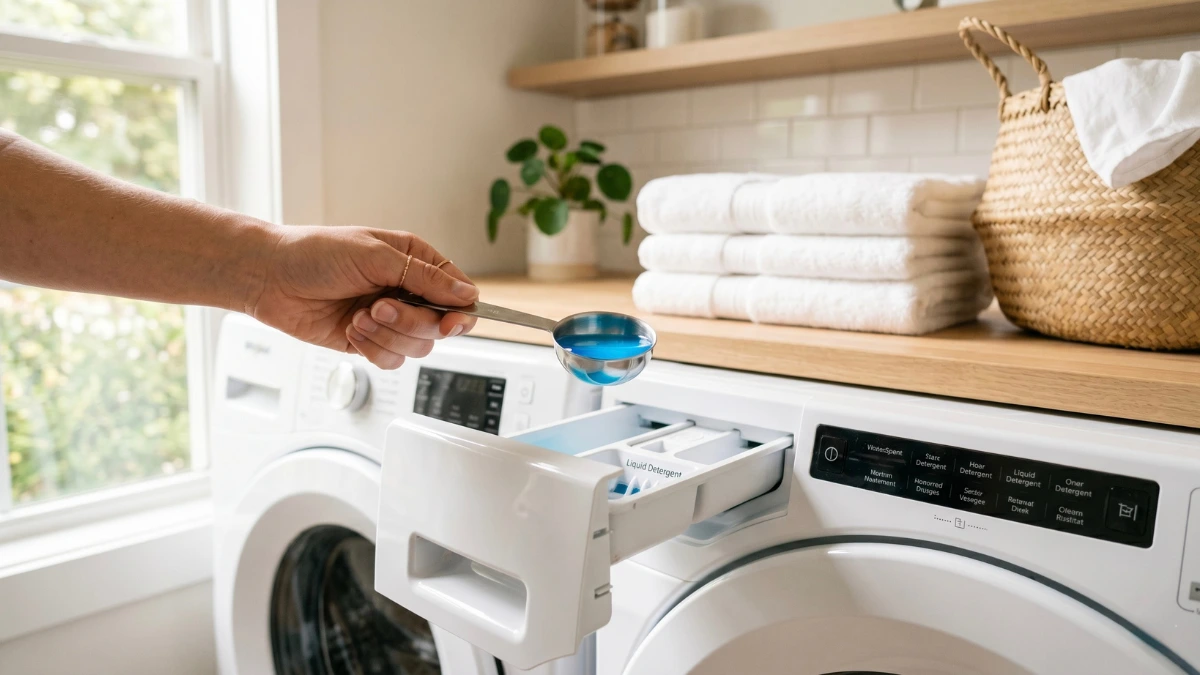
Have you ever pulled a load of laundry from the dryer only to find that your favorite t-shirts feel a bit stiff, or your towels have lost their plush, cloud-like softness? Perhaps you have noticed a faint, lingering mildew scent coming from the washing machine drum, despite regularly running cleaning cycles.
If this sounds familiar, the culprit is likely sitting right on top of your washing machine.
For years, the standard practice has been to fill that plastic detergent cap all the way to the line, or toss in a massive scoop of powder, assuming that more soap equals cleaner clothes. However, a major shift is happening in the world of home maintenance. Appliance repair technicians across the board are stepping forward with a completely different message. They are advocating for what many are calling the “Half-Scoop Hack” (or the “Two-Tablespoon Rule”).
This is not just a passing social media trend; it is a mechanically sound approach to laundry that preserves fabrics, protects expensive appliances, and saves a significant amount of money. Today, we are breaking down the science, the professional recommendations, and the real community feedback behind this highly effective laundry strategy.
The Fallacy of the Measuring Cap
To understand why this hack is necessary, we must first look at the design of commercial laundry detergent packaging. When you buy a bottle of liquid detergent, the cap provided is often enormous. The fill lines are sometimes difficult to read, and the natural inclination is to pour until the cup looks reasonably full.
However, modern washing machines—especially High-Efficiency (HE) models—are engineered to use significantly less water than older agitator models. HE machines rely on the mechanical action of clothes tumbling against each other to lift dirt, rather than drowning them in a vast pool of soapy water. Because these machines use so little water, they require very little detergent.
When you pour a full cap of highly concentrated HE detergent into the dispenser, the machine simply does not have enough water to rinse all that soap away. The excess detergent remains trapped in the fabric fibers and coats the internal mechanisms of the washing machine. Over time, this builds a sticky residue that attracts dirt, traps odors, and heavily damages the appliance.
What Appliance Repair Technicians Are Actually Saying
If you spend any time speaking with appliance repair professionals, you will quickly discover that detergent overdose is one of the leading causes of service calls. Technicians are consistently advising their clients to drastically reduce their soap usage.
According to professional repair academies and seasoned technicians sharing their expertise online, the golden rule for modern High-Efficiency washing machines is surprisingly minimal: you only need one to two tablespoons of liquid detergent for a standard load. Yes, just two tablespoons.
To put that into perspective, a standard shot glass holds about three tablespoons of liquid. The giant plastic cap that comes with your detergent bottle can often hold up to ten times the required amount.
Technicians point out that your washing machine’s sensors cannot tell if you have used too much soap. The machine will use the same amount of rinse water regardless of whether you used two tablespoons or a whole cup. When the rinse cycle finishes, the excess suds remain. This leftover soap scum forms a film inside the drainage system and rubber door seals, becoming a breeding ground for mold and that dreaded musty washing machine smell. In severe cases, the machine has to work much harder to pump out the thick, sudsy water, leading to premature pump failures and expensive repair bills.
The Reddit Verdict: Real Community Experiences
The shift toward minimal detergent use is heavily supported by massive online communities. On platforms like Reddit’s r/laundry community, thousands of users have shared their experiences after testing the advice of appliance technicians.
The consensus is overwhelmingly positive. Users frequently report that after switching to just one or two tablespoons of detergent, the results are immediate. Clothes come out feeling softer, looking brighter, and smelling completely neutral rather than heavily perfumed.
One user on a popular thread noted that a repair technician visiting their home for a routine service told them to use exactly one teaspoon of soap for their front-loading HE machine. The user initially doubted the advice but tried it anyway. They reported that their laundry felt incredibly clean, and a single bottle of detergent began lasting for several months.
Another common observation from these communities is the restoration of old towels. Many people discover that their “scratchy” towels were actually just weighed down by years of microscopic detergent buildup. By using less soap (and occasionally adding half a cup of white vinegar to the rinse cycle to strip away old residue), the towels return to their original, highly absorbent state.
5 Reasons You Need to Switch to the Half-Scoop Hack Today
If you are still hesitating to cut your detergent usage down to two tablespoons, here are five evidence-based reasons to make the switch on your next wash day.
1. It Saves Your Washing Machine from an Early Grave
Washing machines are significant financial investments. By reducing your detergent intake, you prevent soap scum from clogging the drainage hoses, pump mechanisms, and water-level sensors. Excess suds can literally cause mechanical parts to overwork and burn out. Using the correct amount of soap ensures the machine operates efficiently and enjoys a much longer lifespan.
2. Your Clothes Will Actually Get Cleaner
It sounds counterintuitive, but too much soap prevents clothes from getting clean. Washing machines rely on friction. Clothes need to rub against one another to dislodge dirt and oils. When there is a massive amount of suds in the drum, it acts as a cushion, reducing the friction. Furthermore, the unrinsed soap left behind acts as a magnet for new dirt the moment you wear the garment. Less soap means better rinsing, which equals cleaner clothes.
3. You Banish the “Mildew Washer Smell”
That sour, swampy odor coming from the washer is almost always caused by leftover detergent and fabric softener feeding mold growth in dark, damp areas of the machine. When you only use two tablespoons, the machine can easily flush all the residue down the drain. Combine this with leaving the washer door slightly open between cycles, and the mildew smell will become a thing of the past.
4. Your Budget Will Thank You
Premium laundry detergents are not cheap. If you follow the lines on the cap, a standard bottle might last a month. By reducing your usage to one or two tablespoons per load, that same bottle can easily last six months to a year. It is one of the simplest ways to instantly reduce household grocery expenses without sacrificing any quality.
5. It is Better for Sensitive Skin and the Environment
For families with sensitive skin, eczema, or allergies, leftover laundry detergent in clothing can be a major irritant. The chemicals and artificial fragrances meant to wash away instead stay trapped in the fibers next to the skin all day long. Using minimal detergent ensures a complete rinse. Additionally, sending less chemical runoff into the local water system is a wonderful step toward a more eco-friendly household routine.
How to Do the Hack Correctly
Transitioning to this method is incredibly straightforward, but there are a few variables to keep in mind to achieve the absolute best results.
- Determine Your Machine Type: If you own a modern High-Efficiency (HE) machine (most front-loaders and modern top-loaders without a tall center agitator), your baseline is 1 to 2 tablespoons of liquid detergent. For concentrated formulas (labeled 2X or 3X), you might only need 1 tablespoon. If you use powdered detergent, 2 tablespoons is ideal.
- Assess Your Water Hardness: Water hardness plays a crucial role in laundry chemistry. Hard water contains minerals like calcium and magnesium that bind with soap, reducing its cleaning power. If you live in an area with particularly hard water, you may need to increase your detergent dose slightly—perhaps to three tablespoons. Conversely, if you have a water softening system installed in your home, you might need even less than two tablespoons, as soft water lathers exceptionally well.
- Adjust for Soil Level and Load Size: The two-tablespoon rule applies to a standard, regular-sized load of moderately worn daily clothing. If you are washing a heavy-duty load of mud-caked outdoor work gear or highly soiled athletic wear, you will need a bit more cleaning power. However, instead of pouring a massive amount of detergent, experts recommend pre-soaking the heavily soiled items or adding a laundry booster like washing soda. Do not exceed more than an additional 50 percent of your standard dose.
- Reconsider Detergent Pods: While highly convenient, laundry pods are pre-measured for the absolute maximum load size and often contain far more soap than a standard load requires. You cannot easily split a pod in half, meaning you are forced to over-soap your laundry unless you are stuffing the machine to its absolute maximum capacity. Switching to a high-quality liquid or powder allows for precise measuring.
The Final Spin
Changing deeply ingrained household habits can feel strange at first. Pouring a tiny splash of detergent into a massive washing machine drum might make you doubt whether it will do the job. But trust the appliance technicians, the mechanics of modern engineering, and the thousands of people who have already made the switch.
By adopting the Half-Scoop Hack, you are protecting your valuable fabrics, extending the life of a major home appliance, and simplifying your household routine. So next time laundry day arrives, put away the giant measuring cap, grab a simple tablespoon, and prepare to experience the softest, cleanest laundry you have ever had.