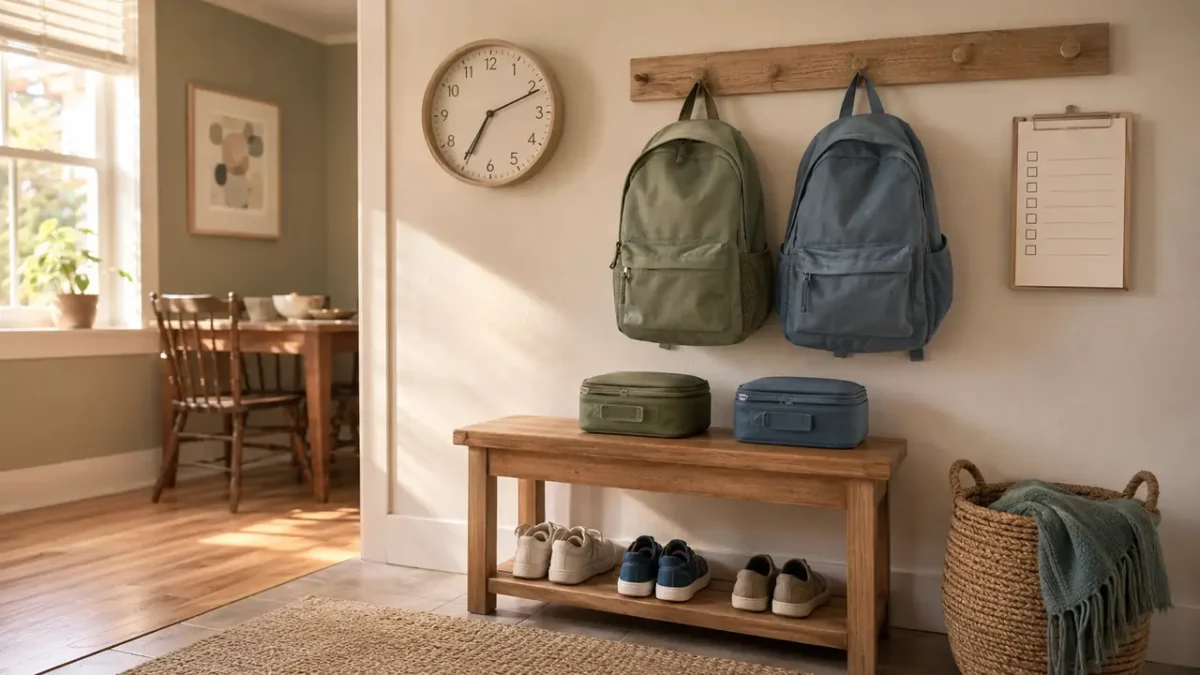
Back-to-school preparation is arriving early in 2026. The National Retail Federation’s July 14 survey found that 62% of shoppers had already started by early July, while 47% planned to buy only the essentials needed for the start of the school year.
That makes this a useful moment to test something no shop can supply: whether the family routine has enough time, clear places, shared responsibility and a safe margin before the door closes.
A new planner or another storage basket can hide a bottleneck for a few days. A one-week school-morning trial shows where the routine actually breaks. Run it during the final week of summer or the first low-pressure school week, change only one variable each day, and keep the changes that genuinely help.
Day 1: Track the Rush Before Fixing It
The first morning is a baseline. Do not wake everyone unusually early, rearrange the entryway or prepare an elaborate breakfast. Follow the current routine and quietly note five moments: wake-up, breakfast started, dressed, bag ready and out of the door.
Also count searches and repeated reminders. The purpose is not to score a child’s behaviour. It is to find the transition that absorbs the most family energy. If shoes take two minutes but finding a signed form takes twelve, the whole morning is not broken; one hand-off point is.
The American Academy of Pediatrics’ guidance on family routines stresses a flexible balance between confusion and excessive rigidity. That is the standard here too. A useful routine should support family duties, kind speech, breakfast, prayer and a safe departure—not turn the home into a stopwatch.
Day 2: Move One Task to the Previous Evening
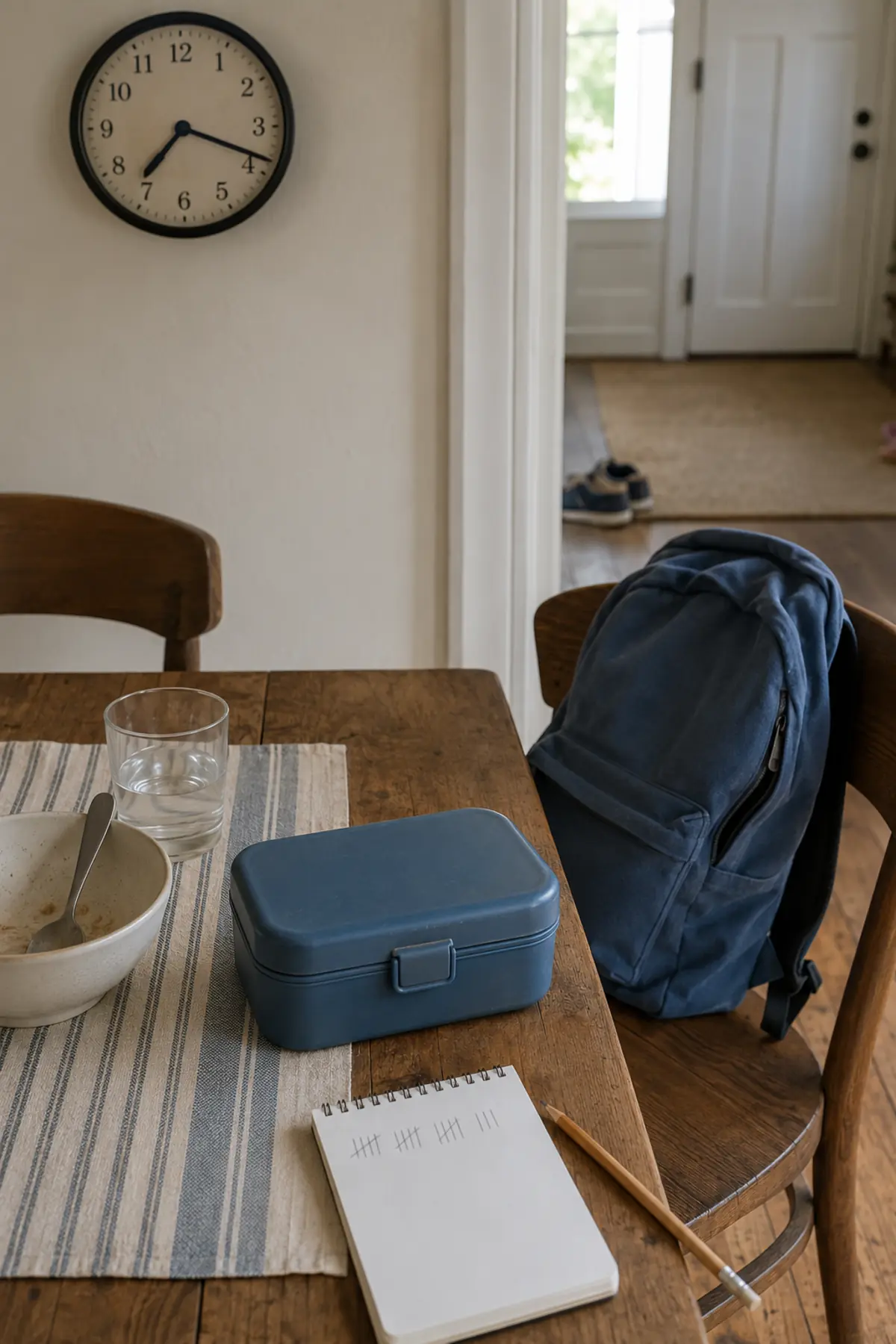
Choose the single task that caused the most delay on Day 1. Lay out a complete modest outfit, put homework inside the bag, freeze the cold pack, sign the form or place the water bottle beside the lunch box. Move only that task.
This matters because “prepare everything the night before” is too broad to diagnose anything. When one moved task improves the next morning, the missing piece is sequence: the job was happening at the wrong time.
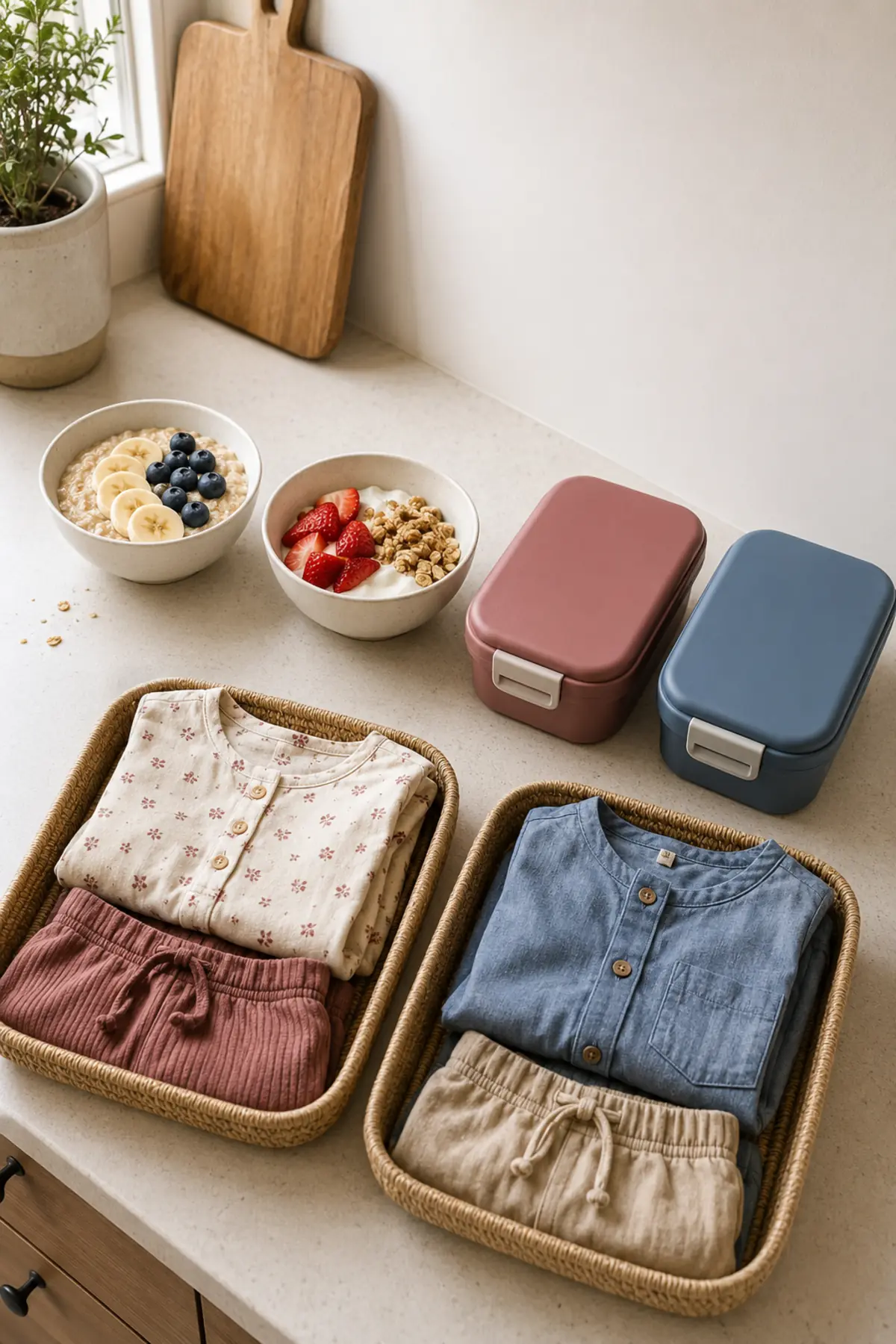
If breakfast and packed-lunch equipment are the problem, the 15-minute summer kitchen reset gives those items a short, visible route without leaving perishable food out overnight.

Day 3: Give the Repeatedly Lost Items One Home
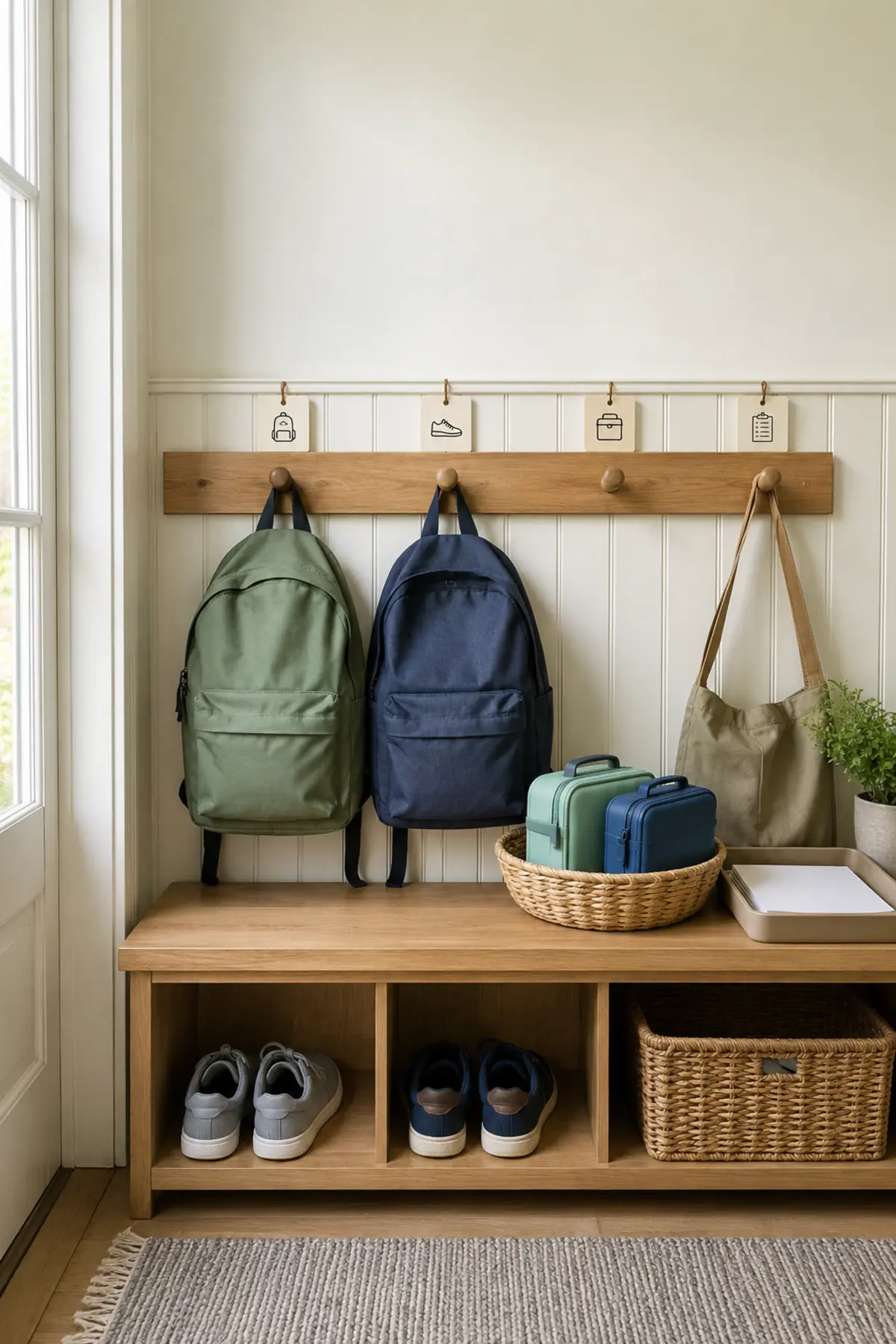
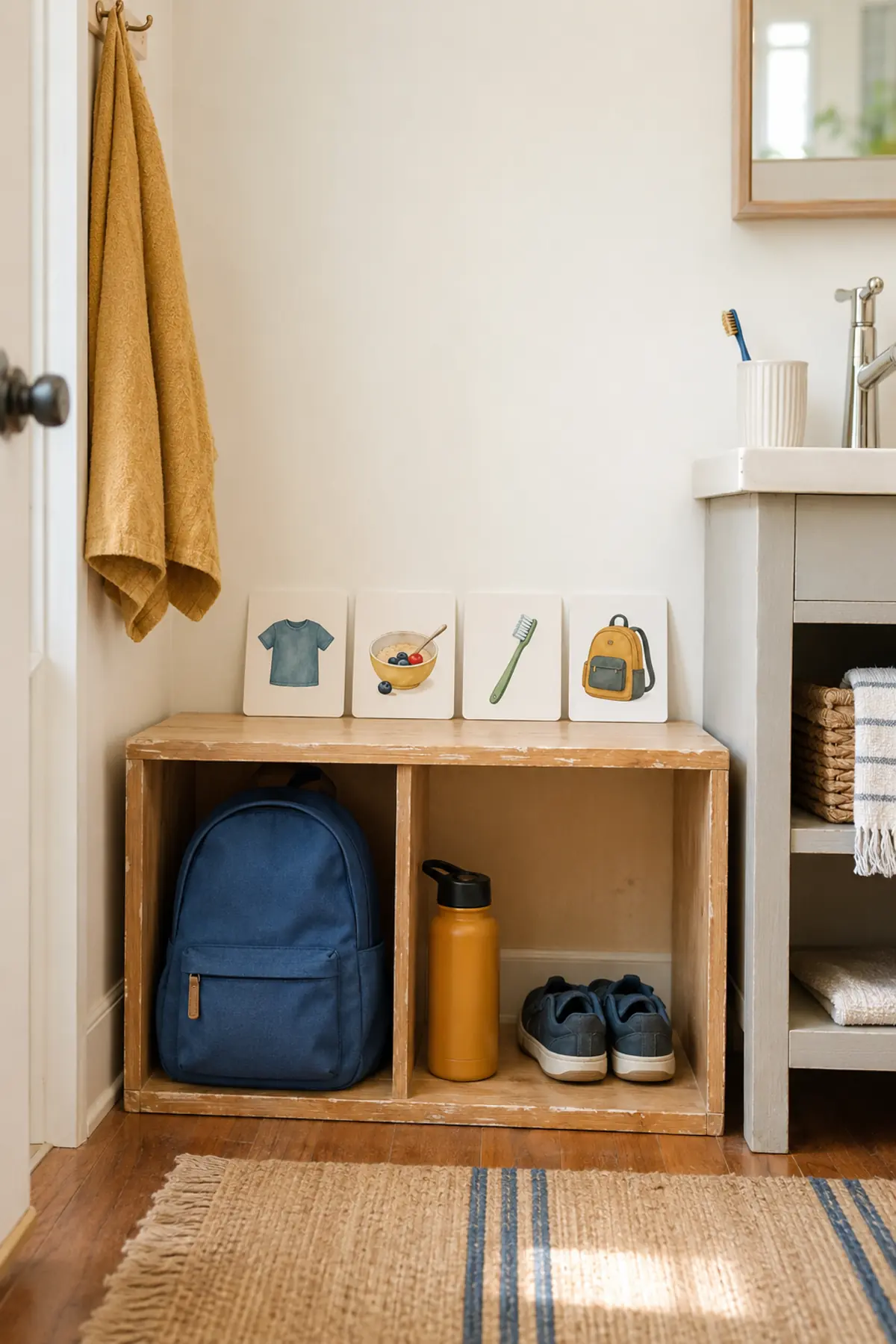
Today, watch for searching. Backpacks on one hook, shoes on one shelf, lunch boxes in one basket and school papers in one tray are enough. Reuse what the home already has before buying organisers.
The key is reach, not appearance. A basket that photographs beautifully but sits above a child’s reach still leaves the parent carrying the routine. Put everyday items where the person responsible for them can actually return them.
If searches disappear, the missing piece was place. Keep the small landing zone and resist expanding it into a complicated command centre that needs its own maintenance.
Day 4: Cap Choices Without Removing Dignity
Offer two suitable breakfast options or two weather-appropriate outfits that meet the household’s standards of modest dress. A limited choice still respects preference while removing a long decision from the busiest part of the day.
This is not about controlling every detail. The AAP’s family-routine guidance likewise recommends offering children a choice where possible to reduce last-minute disputes. The useful limit is two acceptable answers, not an open-ended search through every cupboard or drawer.
If the family leaves more smoothly, the missing piece was decision load. Keep the two-choice rule only for the decisions that regularly stall the morning.
Day 5: Hand Over One Age-Appropriate Responsibility
Choose one step a child can own consistently. A younger child might place a water bottle beside the bag. An older child can check a simple picture list. A teenager can manage an alarm, outfit and packed bag within the family’s agreed rules.
Ownership means responsibility, not blame. Parents should still verify safety-critical items, medication and important forms. The aim is to stop storing the entire routine inside one adult’s head.
If repeated reminders fall, the missing piece was ownership. Keep that one responsibility steady for several weeks before adding another.
Day 6: Protect a Ten-Minute Departure Buffer
Set “ready” time ten minutes earlier than “leave” time. Those minutes are not available for one more chore. They absorb a missing shoe, a bathroom return, a changed bus time or the quiet goodbye that disappears when everyone is racing the clock.
Keep the buffer screen-free. In a Muslim home, salah should never be treated as a leftover task squeezed into spare minutes; wake-up and departure should be planned so prayer is protected at its proper time. The sleep calculation therefore runs backwards from the household’s local Fajr and school-departure time, not from a habitual bedtime. A composed morning also leaves room for du’a, kind words and checking that everyone leaves safely.
If the buffer vanishes every day before anyone reaches the door, the schedule itself may be too tight. Check the previous evening as well. The CDC lists 9–12 hours of sleep for ages 6–12 and 8–10 hours for ages 13–18, and the AAP recommends shifting bedtime a week or two before school begins rather than trying to solve tiredness with a harsher alarm.
Simple arithmetic can expose a gap: 8:30 p.m. to 6:30 a.m. allows ten hours, while 9:30 p.m. to 5:30 a.m. allows eight. These are illustrations, not universal schedules; local ‘Isha and Fajr times, the journey to school, age and individual sleep needs should shape each household’s actual plan.
An authentic report in Sahih al-Bukhari 568 states that the Messenger of Allah ﷺ disliked sleep before ‘Isha and idle conversation after it — a pattern that guards both the night prayer and a rested Fajr. The principle is fixed; the clock is not. Because ‘Isha and Fajr shift with place and season, the Prophetic standard is an early, purposeful night rather than one bedtime repeated everywhere.

Day 7: Name the Missing Piece and Keep Only Two Changes
Run one final rehearsal at the real school departure time. Then review the week using the Women’s Alphabet Five-Piece Morning Check:
- Time: Did one transition consistently take longer than the schedule allowed?
- Place: Did the family repeatedly search for the same items?
- Choice: Did open-ended decisions delay breakfast, dressing or departure?
- Ownership: Did every instruction and check depend on one adult?
- Margin: Did a small surprise collapse the whole morning?
Choose the two changes that produced the clearest improvement. More than two can make it impossible to tell what worked and can burden the family with a routine that looks organised but is difficult to sustain.
The best school-morning routine is not the prettiest one on a screen. It is the one that protects sleep, responsibilities, prayer, nourishment, safety and gentle family conduct while getting everyone where they need to be. A week is long enough to reveal the missing piece—and short enough to fix it before the first-bell rush becomes the household’s normal.

A Note from Women’s Alphabet
Women’s Alphabet does not sell the products shown in these images. The visuals are editorial concept images for inspiration, not product listings or exact purchasing recommendations. Adapt any family routine to each child’s age, needs, school schedule and household responsibilities.