

Does Sticking a Wooden Skewer in a Potato Actually Bake It Faster?
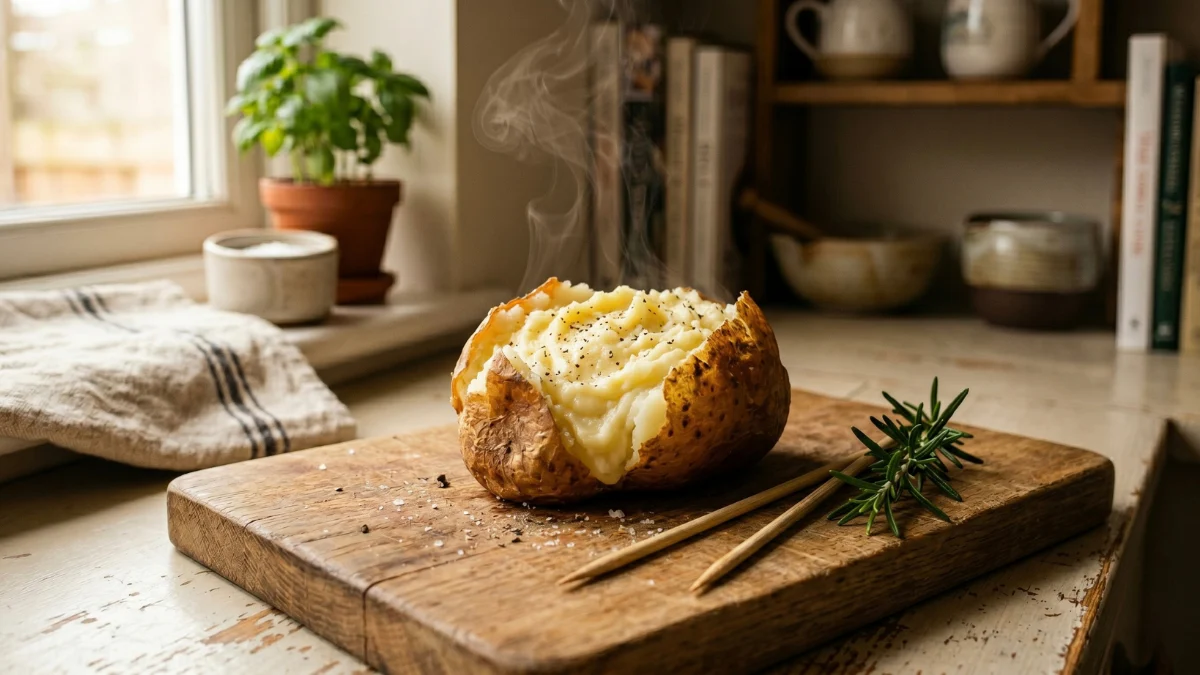
We have all been there. The dinner table is nearly ready, the main courses are perfectly warmed, and the only thing holding up the entire meal is a batch of stubbornly firm baked potatoes. The humble baked potato is a universally beloved comfort food, boasting a beautifully crispy skin and a fluffy, cloud-like interior. However, culinary perfection takes time—often upwards of an hour in a standard kitchen oven. In our fast-paced daily routines, waiting 60 minutes for a simple side dish can feel like an absolute eternity. This shared impatience has naturally fueled the rise of countless kitchen hacks and viral internet tricks that claim to significantly slash your cooking times.
One of the most persistent rumors floating around contemporary culinary forums and social media feeds is the idea that sticking a wooden skewer directly through the center of a potato will help it bake significantly faster. The underlying logic seems entirely sound at first glance: piercing the center opens up a direct channel for heat to travel directly into the core, theoretically cooking the dense vegetable from the inside out. But does this widely shared trick actually work in practice, or is it just another kitchen myth waiting to be officially debunked? When diving deep into the details of the science of heat transfer and real community experiences, it becomes incredibly clear that we need to look closer at the facts.
The Core Question: Wood vs. Metal Heat Conduction
To answer the central question immediately and directly: No, sticking a wooden skewer into your potato will not bake it faster. In fact, relying on it for speed might leave you waiting just as long.
The widespread misconception stems from a very real, scientifically sound kitchen tool known historically as the “potato nail.” Decades ago, specialized aluminum potato nails were a highly popular gadget in home kitchens, and they are still discussed today. The fundamental concept is based entirely on thermal conductivity. Metal is an excellent, highly efficient conductor of heat. When a thick metal spike is inserted into a raw potato and placed in a hot oven, the exposed metal absorbs the ambient heat and aggressively channels it directly into the center of the potato. This means the potato is simultaneously baking from the ambient hot air on the outside and the radiating hot metal on the inside.
Wood, on the other hand, is a natural thermal insulator. Think about why thick wooden spoons are the preferred tool for stirring violently boiling soups or hot caramel; they simply do not conduct heat well, naturally keeping your hands safe from severe burns. When a wooden skewer is inserted into a raw potato, it absorbs very little heat from the surrounding oven environment. Instead of acting as an efficient thermal bridge to the core, the wood simply sits there. While the tiny punctured hole might release a minuscule amount of internal steam, the wooden skewer itself does absolutely nothing to speed up the internal cooking process. Attempting to use wood to accelerate baking is a classic case of mistaken materials.
The Science of Baking and Heat Transfer
Understanding exactly why the wooden skewer fails requires a quick but fascinating look at the underlying science of baking and thermodynamics. Potatoes inherently possess a very high water content and an exceptionally high specific heat capacity. In simple terms, this means they demand a substantial amount of continuous energy—in the form of heat—over a sustained period to raise their internal temperature enough to properly break down the rigid starches. Only when this high temperature is reached does the interior achieve that desired fluffy, soft texture.
In a conventional home oven, heat transfers to the food primarily through convection (the ambient hot air circulating constantly around the food) and conduction (the direct heat moving from the hot metal baking sheet directly into the bottom of the potato). Interestingly, the ambient air inside an oven is actually a relatively poor conductor of heat when compared to direct contact with solid metal or boiling water. This scientific principle is exactly why you can safely reach your bare hand into a 400°F (200°C) oven for a brief second to grab a pan, but touching boiling water at only 212°F (100°C) will cause an instant burn.
When trying to actively speed up the baking process of a dense root vegetable, the primary goal is to drastically increase the rate of direct heat transfer. A metal skewer provides a dense, highly conductive physical pathway. A wooden skewer, being naturally porous and insulating, offers no such advantage whatsoever.
What the Online Community Actually Says
When exploring platforms where home cooks share their unvarnished kitchen experiments, the consensus on potato skewers is wonderfully clear. In deeply detailed discussions on the popular r/Cooking community on Reddit, users frequently discuss the genuine efficacy of old-school aluminum potato nails versus modern alternatives.
One active user, who previously conducted a structured science fair experiment on the topic, noted that using a standard aluminum nail only sped up the baking process by about 10 minutes on a standard 60-minute bake. Another user astutely pointed out that purposefully leaving the metal nail exposed by an inch or two outside the potato helped it gather significantly more ambient heat, pushing the overall time savings to about 15 minutes.
However, community members are always quick to emphasize the physical limitations. As one Reddit user (MrCockingFinally) aptly explained the fundamental physics:
“Heat transfer depends on surface area. The cross section of the nail isn’t that big. And pure conduction isn’t actually that fast. Think of putting an iron poker in a fire. The handle will stay cool for a very long time.”
Further discussions on boards like r/CasualUK highlight the distinct safety benefits of generally poking potatoes. While piercing the thick skin (whether with a fork, a sharp knife, or a wooden skewer) does not drastically speed up the cooking time, it remains an absolutely essential step to prevent the potato from violently exploding. Intense steam naturally builds up inside the dense flesh as the internal water content rapidly heats up. Poking deep holes allows that pressurized steam to escape safely and quietly, keeping your oven interior perfectly clean.
What Are Wooden Skewers Actually Good For?
While wooden skewers will definitely not win any speed-baking awards, they remain an absolute powerhouse tool in the kitchen when it comes to preparing potatoes. Their true value lies not in heat conduction, but in reliable structural support and intricate culinary design.
Crafting Flawless Hasselback Potatoes
If you want to elevate a standard side dish into a visually stunning, restaurant-quality centerpiece, wooden skewers are your absolute best friend for preparing Hasselback or Accordion potatoes. The technique is brilliant in its sheer simplicity and yields a texture that is truly unparalleled.
By placing a raw potato on a flat cutting board and laying a standard wooden skewer flat on either side of it, you build a sturdy physical barrier for your kitchen knife. As you slice downward through the potato at regular, narrow intervals, the sharp edge of the knife blade hits the wooden skewers, preventing you from accidentally cutting all the way through the base. This allows you to effortlessly produce deep, perfectly even cuts along the entire length of the vegetable, while ensuring the bottom remains fully intact to securely hold the delicate slices together. Once you generously brush these deep crevices with seasoned olive oil, melted butter, garlic powder, and fresh herbs, the thin slices naturally fan out beautifully as they roast in the oven. The final result is a hybrid masterpiece that features the incredibly crispy, golden-brown edges of a premium french fry, paired flawlessly with the soft, fluffy interior of a traditional baked potato.
Designing Viral Tornado Potatoes
Similarly, wooden skewers are the essential backbone for developing the incredibly popular Tornado potatoes—also widely known across modern social media platforms as spiral potatoes or twisted potatoes. This viral culinary trend involves carefully threading a whole, thoroughly washed potato onto a thick, sturdy wooden skewer. Using a small, exceptionally sharp knife, you then cut a continuous, deliberate spiral motion all the way down the entire length of the vegetable until the blade gently taps the wood inside.
Once the entire potato is completely scored, you gently pull and stretch the potato apart along the wooden skewer, transforming it into a long, coiled shape that perfectly resembles a loose spring. This twisted structure can then be heavily seasoned and either deep-fried or baked until it reaches an ultimate level of satisfying crunch. For this specific high-heat application, heavily soaking the wooden skewers in a deep bowl of cold water for at least 30 minutes beforehand is a highly recommended and necessary step to prevent the dry wood from burning, smoking, or splintering in the intense heat of the oven or frying oil.
Proven Methods to Speed Up Potato Baking
Since the wooden skewer trick is officially debunked for speed, how can one actually get a perfectly baked potato on the dining table much faster without sacrificing the beloved texture? The online culinary community and professional food science experts largely agree on a few thoroughly proven methods:
- The Microwave Kickstart: This method is the undisputed, heavyweight champion of the busy weeknight potato. By securely microwaving a deeply pierced potato for just 5 to 6 minutes, you rapidly heat the dense, water-heavy interior using electromagnetic waves. Once the core is slightly softened and steaming, carefully transfer it to a hot oven (around 400°F or 200°C) directly on the wire rack for another 15 to 20 minutes. This hybrid method reliably cuts the total cooking time in half while still delivering the undeniably crispy, deeply roasted oven-baked skin that microwaving alone simply cannot achieve.
- The Strategic Halving Method: If the visual aesthetic presentation of a whole, uncut potato is not strictly necessary for your meal, simply cutting the potatoes in half lengthwise will dramatically reduce the total baking time. Rub the exposed cut sides generously with a little olive oil, coarse salt, and black pepper, and place them face-down on a heavy, dark baking sheet. The large flat surface actively maximizes direct contact with the hot metal pan, encouraging incredibly fast heat conduction and seamlessly developing a deeply browned, intensely flavorful crust on the bottom.
- Utilizing Convection Baking: If your modern home oven features a dedicated convection setting, this is the perfect time to use it to your absolute advantage. Convection technology utilizes a built-in exhaust fan to circulate the hot oven air continuously and rapidly around the food. In a standard oven, the potato is surrounded by a microscopic layer of cooler air that acts as an invisible thermal blanket, slowing down the cooking process. The convection fan actively strips away this insulating layer, forcing the intense heat to penetrate the skin much faster. By ensuring a steady stream of hot air is always in direct contact with the surface, convection cooking generally cooks dense foods roughly 25% quicker than conventional radiant baking.
- Skip the Aluminum Foil: Tightly wrapping a potato in aluminum foil before baking is a very common historical practice, but it is entirely counterproductive if a wonderfully crispy skin is your ultimate goal. Foil immediately traps the moisture and steam naturally escaping from the heating potato, effectively boiling the vegetable in its own contained juices. This inevitably results in a wet, remarkably soggy exterior. For the absolute best authentic texture, always leave the potato completely unwrapped while it bakes.
Achieving the Perfect Fluffy Texture
Once the potato is finally completely tender—which you can easily and accurately test by sliding a standard wooden skewer deep into the flesh; it should meet absolutely zero physical resistance—the final handling step is incredibly crucial for ensuring the fluffiest possible interior.
Renowned food writers and critics, such as Nigel Slater, highly recommend utilizing the “karate-chop” method to open the spud. Instead of slicing the baked potato cleanly down the middle with a sharp knife, carefully give the hot baked potato a swift, gentle chop with the side of your hand (or firmly use a dining fork to press both sides inward simultaneously) to vigorously crack the thick skin open. This sudden, forceful physical rupture allows a massive, immediate burst of trapped steam to escape instantly. Releasing this steam prevents the internal moisture from condensing back into the starch and making the flesh heavy or gluey. The beautiful result is a snowy, remarkably light, and perfectly crumbly interior that is entirely ready to absorb your favorite butter, sour cream, and fresh chives.
Final Thoughts on Kitchen Hacks
The digital landscape is absolutely full of enticing shortcuts and clever tricks, but deeply understanding the basic, foundational principles of cooking thermodynamics ensures you do not waste precious time on methods that simply lack a factual scientific foundation. While the old-fashioned metal potato nail offers a modest, respectable reduction in overall baking time, the wooden skewer is undoubtedly best reserved for forming intricate, beautiful cuts, safely guiding your kitchen knife, and accurately testing for ultimate doneness.
By confidently embracing a strategic combination of microwave kickstarting and high-heat oven-roasting, you can consistently deliver perfectly baked, steaming potatoes to the dinner table without enduring the grueling hour-long wait. Equip your home kitchen with the right factual knowledge, trust the proven science of heat transfer, and let the real culinary results speak for themselves.