

The Viral Baking Soda Mattress Trick: How to Neutralize Sweat Odors (Without Ruining Your Vacuum!)
Let’s be completely honest for a second: we spend about a third of our lives in bed. We religiously wash our sheets, swap out our pillowcases, and invest in aesthetic duvet covers. But when was the last time you actually cleaned the mattress itself?
If you are like most people, your mattress is probably harboring a secret buildup of night sweat, body oils, and dead skin cells. Over time, this natural buildup leads to a subtle, stale odor that fresh sheets just can’t hide. Enter the viral “baking soda on the mattress” trick. If you spend any time on cleaning threads on Reddit (looking at you, r/CleaningTips) or scrolling through Pinterest, you have undoubtedly seen people generously dusting their beds with white powder.
But does it actually work? And more importantly, is it safe for your expensive vacuum cleaner?
Grab your coffee, because we are diving deep into the science of mattress freshening, exactly how to do it right, and the massive vacuum warning that most internet tutorials completely leave out.
The Chemistry: Why Baking Soda is a Heavyweight Odor Fighter
Before you start sprinkling your pantry staples all over your bedroom, it helps to understand why this method is so highly recommended by home cleaning experts.
Baking soda, or sodium bicarbonate, is not just a baking ingredient; it is an alkaline powder. Throughout the night, our bodies release sweat and natural oils, which are mildly acidic. When these acidic compounds settle into the fabric of your mattress, they start to smell stale.
When you apply baking soda to the surface, an actual acid-base reaction occurs. The baking soda neutralizes the acidic odor molecules at a chemical level. Instead of just masking the smell with a heavy floral perfume—like many commercial fabric sprays do—baking soda physically eliminates the odor.
Furthermore, baking soda acts as a powerful desiccant. It absorbs lingering moisture and dampness trapped in the top layers of your mattress fabric. Since dust mites and bacteria thrive in slightly damp, warm environments, pulling that moisture out forms a much less hospitable environment for them.
Pre-Treatment: What You Must Do First
A common misconception is that baking soda will erase yellow sweat rings or deep stains. It will not. Baking soda is a deodorizer and a mild abrasive, but it cannot dissolve heavy biological stains on its own.
If your mattress has visible yellowing from sweat or minor accidents, you need to spot-treat those areas before you apply any powder.
- For Sweat and Urine Stains: Use an enzyme cleaner. You can find these cheaply at pet supply stores. Enzymes actually digest the organic proteins causing the stain. Spray lightly, blot with a dry microfiber cloth, and let it dry completely.
- For Blood Stains: Always use cold water. Hot water permanently sets protein stains. Mix a simple solution of 3% hydrogen peroxide and a few drops of mild dish soap. Dab it onto the spot, wait a few minutes, and blot it away.
Important rule: Never soak your mattress. Memory foam and latex can develop mold very quickly if they become over-saturated. Always apply liquids sparingly and blot aggressively.
The Step-by-Step Guide to the Baking Soda Trick
Once your mattress is dry from any spot treatments, you are ready for the main event. Here is how to execute the trick flawlessly.
Step 1: Strip and Wash on Hot Remove every layer of bedding, including the mattress protector. Wash them immediately. To effectively eliminate dust mites, water temperature matters. Wash your bedding at 60°C (140°F) or higher.
Step 2: The Initial Dry Vacuum Before adding powder, vacuum the bare mattress. Use the upholstery attachment and go over the entire surface in slow, overlapping rows. Pay special attention to the seams, tufts, and edges, as this is where dust and dead skin cells accumulate the most.
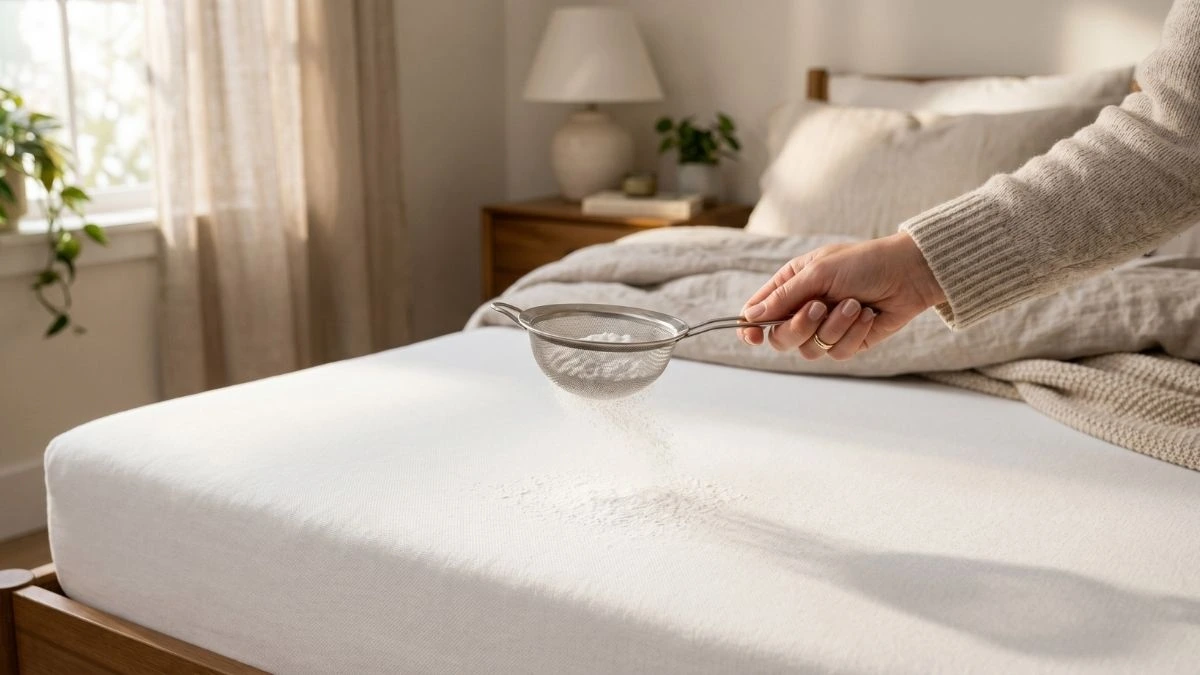
Step 3: The Sieve Method Do not just dump the baking soda directly from the cardboard box; you will end up with heavy mounds in some areas and nothing in others. Instead, pour about 200 to 300 grams (roughly one cup) of baking soda into a fine mesh kitchen strainer. Gently tap the side of the strainer to dust a fine, even layer across the entire mattress.
Step 4: The Waiting Game Patience is the secret ingredient here. If you sweep it up after ten minutes, you are wasting your time. According to extensive household testing, leaving baking soda on for 2 hours eliminates about 65% of odors. Leaving it for 8 to 12 hours eliminates closer to 95%. Pro-Tip: Make this a morning routine. Strip the bed before you head to work, apply the baking soda, and let it sit all day.
Step 5: The Final Vacuum Once the powder has had hours to absorb moisture and neutralize acids, it is time to vacuum it up. Go slowly, passing over each section multiple times to ensure no gritty residue is left behind to irritate your skin through the sheets.
The Massive Warning: Will Baking Soda Ruin Your Vacuum?
This is the most critical part of this guide, and the reason many cleaning professionals caution against viral internet hacks. Baking soda can absolutely destroy a bagless vacuum cleaner.
Here is the problem: Baking soda particles are microscopic—much finer than standard household dust. When you vacuum them up with a standard bagless machine (like a Dyson or Shark), these tiny particles can easily bypass the primary filtration cyclones. They clog the HEPA filters almost instantly, which chokes the machine’s airflow. Worse, if the powder breaches the filter, it enters the electric motor. The powder can short out the motor, fall into the bearings, and act like sandpaper, permanently destroying your expensive appliance.
If you spend five minutes browsing r/CleaningTips, you will find countless horror stories of people burning out their vacuum motors after trying this exact mattress trick.
How to do it safely:
- Use a Shop-Vac: If you have a heavy-duty wet/dry shop vacuum in the garage, use that. They are built to handle fine construction dust and will not be bothered by baking soda.
- Use a Bagged Vacuum: Vacuums with thick, high-quality disposable bags handle fine powders much better than bagless models because the bag itself acts as a massive filter.
- Clean the Filter Immediately: If you must use your bagless upright vacuum, empty the canister the moment you finish the mattress. Then, take out the washable filters, rinse them completely clean, and let them air dry for 24 hours. Do not skip this step!
The Essential Oil Debate
Many influencers suggest adding 10 to 15 drops of essential oil (like lavender or eucalyptus) to the baking soda before sprinkling it. Lavender is known for promoting relaxation and deep sleep, making it a tempting addition.
However, be cautious. Oils are liquid, and baking soda is a powder. If you drop oil straight into the box, it will form heavy clumps that won’t sift through your strainer. If you want a scent, put your baking soda in a mixing bowl first, add the drops of oil, and use a metal whisk to thoroughly break apart any clumps until the powder is smooth and uniform again.
Setting Realistic Expectations
The baking soda trick is an incredibly effective maintenance routine, but it has limits.
- It Does Not Kill Bed Bugs: If you have a pest issue, baking soda will do absolutely nothing to solve it. You need professional extermination.
- It Does Not Replace a Protector: The absolute best way to keep your mattress fresh is to stop sweat from reaching it in the first place. A high-quality, breathable, waterproof mattress protector is a non-negotiable investment for your bed.
Deep cleaning your mattress every 3 to 6 months using this technique will extend its lifespan, keep your bedroom smelling wonderfully neutral, and give you serious peace of mind when you lay your head down at night. Just remember to treat your vacuum cleaner with the same level of care, and enjoy your incredibly fresh, clean bed!
Have you ever tried the baking soda mattress trick? What kind of vacuum did you use, and did it make a noticeable difference in your bedroom? Share your experiences below!