Back-to-school planning is already underway in many families: the National Retail Federation reported that 62% of shoppers had started buying for the school year by early July 2026. But the most useful preparation may not be another desk, cart or matching organizer. It may be a homework station that can work properly for a child and then leave the dining table ready for supper.
That distinction matters in a shared home. The dining table may be the place for meals, family conversation, paperwork and everyday responsibilities. A practical homework setup should give schoolwork a clear boundary without making the whole room feel like a classroom. The aim is a small, repeatable station that supports focus, child-appropriate responsibility and a clean return to family life.
Start With the Table’s Non-Negotiable Boundary
Before buying anything, decide how much of the dining table homework is actually allowed to occupy. A child may need room for a notebook, one book, a pencil case and perhaps a device; that does not mean every school item needs to live on the table all afternoon.
Mark a modest working footprint with a thin mat, a folded sheet of paper or the edge of a tray. Keep the rest of the surface visibly available. This simple boundary gives the child a real place to work while protecting the part of the table that the family still needs for eating and gathering.
The American Academy of Pediatrics recommends a regular homework location that is well lit and reasonably free from distractions, but it does not have to be a separate bedroom desk. A dining table can work when the household agrees on where the work begins and where it ends.

Choose a Station That Can Leave in One Carry
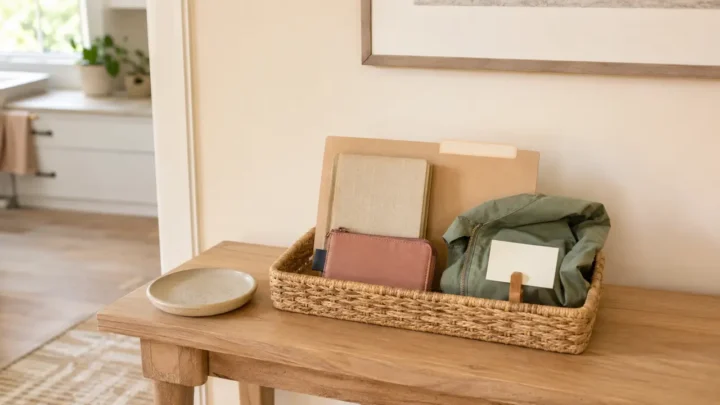
The most useful homework storage is often shallow, portable and easy to park. A tray or low caddy can hold the items used most days: pencils, an eraser, a ruler, the current notebook and one folder for active papers. The rest can stay elsewhere until a real assignment requires it.
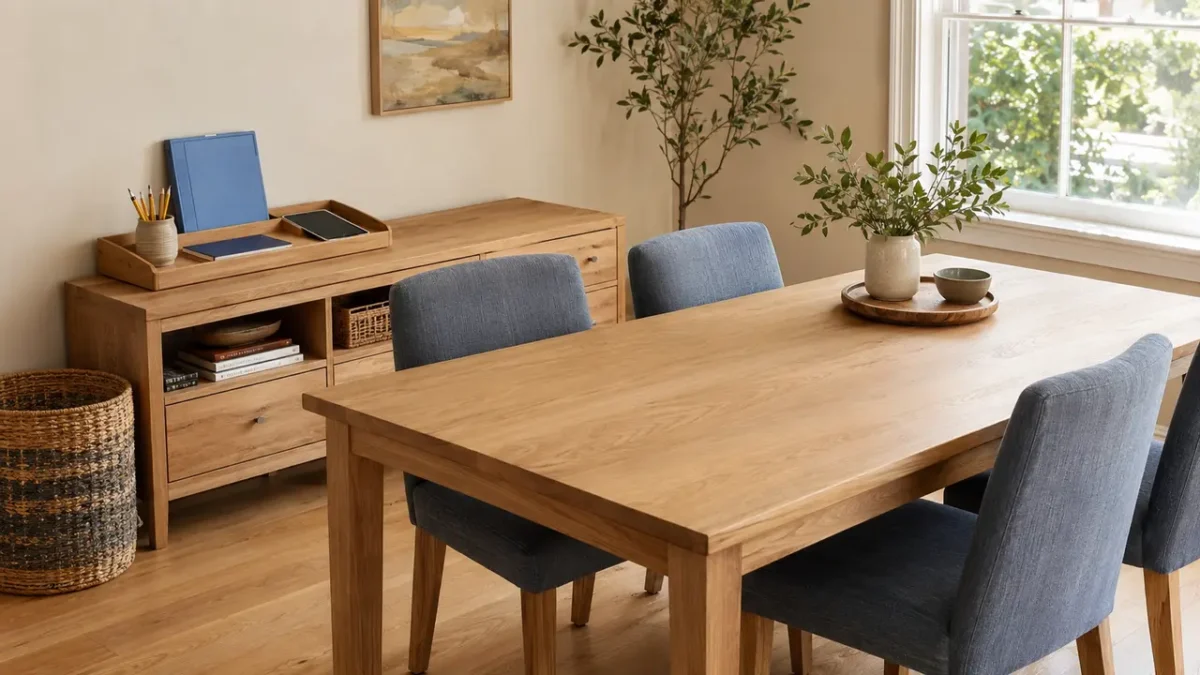
Park the station on a sideboard, a low shelf or another stable surface near the dining area. The storage spot should be reachable by the child who is expected to use it. If an adult must lift a heavy box, open a complicated cabinet or sort several containers before homework can begin, the setup is storing the routine inside the adult’s head.
Keep the tray free of unrelated items. Lunch equipment, craft materials, old worksheets and random household objects make the station look full while making the actual task harder to start. A smaller, honest station is easier to return and easier to notice when something is missing.

The Women’s Alphabet One-Carry Homework Station Test
A station earns its place in a shared dining room when it passes four practical questions. This is the Women’s Alphabet One-Carry Homework Station Test:
- Carry: Can the everyday homework items move together in one trip?
- Clear: Can the table become meal-ready without a second sorting project?
- Find: Does unfinished work have one known place instead of several loose piles?
- Repeat: Can the child rebuild the arrangement without waiting for an adult to rescue it?
If one answer is no, change the boundary or the parking place before buying more storage. A larger container often hides the problem rather than solving it. The right station is not the one that holds the most; it is the one that makes the next start and the next close obvious.

Match the Contents to the Work, Not to an Ideal School Room
Different children need different tools, and the same child may need different tools across the week. Begin with what assignments actually require. Paper-first work may need a notebook, pencil, eraser and a folder. Device-supported work may need a charger kept safely out of the walking path, a calculator or a clear place for paper beside the screen.
Let the child have a reasonable say in the arrangement. The goal is not to hand over every household decision; it is to make the station familiar enough that the child can use and restore it. A younger child may need fewer, clearly visible items. An older student may need a deeper work surface, but still does not need every textbook and supply permanently displayed.
For screen-based assignments, place the device directly in front of the user when possible, reduce window glare and adjust the setup for comfort rather than appearance. The evidence-based computer-use guidance available through the CDC archive recommends a screen at or below eye height, roughly arm’s length away as a starting point, and a workstation that allows movement instead of one fixed posture for a long stretch.

Build a Closing Sequence That Protects Mealtimes
The station is only successful if it disappears when the family needs the table. Make the closing sequence short enough to repeat:
- Mark the next page or place the unfinished paper in the active folder.
- Return pencils and small tools to the caddy.
- Put the notebook and folder in the tray rather than leaving them as a loose stack.
- Carry the tray back to its parking place.
- Clear crumbs, scraps or eraser dust from the table before the next use.
Do not turn this into a punishment or a frantic race. The table belongs to the whole household, and returning it is a normal part of using a shared space. In a Muslim home, family meals, prayer and other duties should not be pushed aside simply because school materials have spread across the nearest surface. A good arrangement supports responsibility without allowing one task to consume every room.
If papers are repeatedly forgotten, add one plainly marked active-work slot. If supplies keep migrating, reduce the number of items in the caddy. If the child cannot finish before the table is needed, the answer may be a different homework time or a small alternate surface—not a permanent pile on the dining table.

Test the Arrangement for Three Ordinary Evenings
Do not judge the station from one carefully staged photograph. Try it on three ordinary evenings, including one evening when dinner preparation or another family duty is already happening.
At the end of each evening, ask four questions: Did the work fit the chosen footprint? Did the child know where to put unfinished pages? Could the station leave in one carry? Did the table become usable without an adult sorting a large pile?
Change only the failed point. Move the parking place if the route is awkward. Remove supplies if the caddy attracts clutter. Add a second small tray only if two children genuinely need separate tools. Keep the arrangement that still works on an ordinary evening, not the one that looks most complete when nobody is using it.

Common Homework Station Problems and Simple Fixes
The station keeps spreading across the table
The boundary may be too vague, or the tray may be too small for the actual daily tools. Remove anything used less than once or twice a week and give those items a different home.
The child forgets what is unfinished
Use one active-work folder or one clearly defined section of the caddy. “Somewhere on the table” is not a storage system, even when the table is cleared only a few minutes later.
The dining room is too distracting
Quiet does not have to mean silent or isolated. Move the homework window away from the busiest part of meal preparation, switch off unrelated screens and keep only the tools needed for the assignment in view. The AAP notes that there is no universally correct homework time; children differ in when they transition best from school, play and rest.
The family needs a permanent study corner instead
A portable station is not a rule that every child must work at the dining table. If the home has a safe, comfortable place for a fixed desk, use it. Women’s Alphabet’s guide to small study corners explores that different problem. This article is for the family that needs schoolwork to have a reliable home without giving up a whole room or the dining table.
Frequently Asked Questions
Does a homework station have to include a desk?
No. A dining table, kitchen counter or another stable surface can work when it is well lit, reasonably calm and governed by a clear start-and-close routine. The station is the repeatable arrangement of tools and boundaries, not a particular piece of furniture.
How much should stay in the caddy?
Keep the items used for ordinary assignments and move specialist supplies in only when needed. If the caddy is difficult to carry or the child cannot see what is inside, it is holding too much.
What if two children share the dining table?
Give each child a defined footprint and a small personal tray, then share the larger supplies only when they are genuinely used by both. Separate active-work folders prevent one child’s unfinished papers from becoming another child’s clutter.
Should the table be completely empty after homework?
It should be ready for its next household use. A single washable mat or a small everyday centerpiece may stay if it does not block the work footprint, but homework papers and tools should have a separate parking place.
The best homework station does not make the home look like a school. It gives a child a dependable place to begin, a clear way to finish and a simple path back to the dining table. That is enough structure to support learning while leaving room for meals, family duties, prayer and ordinary life.