

The “Baking Soda and Vinegar” Drain Hack You Actually Need to Stop Doing
If you have ever stood over a slow-draining sink, desperately hoping to avoid a hefty plumber’s bill, you have probably tried the internet’s most famous DIY plumbing solution. You pour down a generous mound of white powder, follow it up with clear liquid, and watch as a volcanic, satisfying fizz erupts in your sink. It looks powerful. It sounds like it is obliterating that stubborn clog. But here is the hard truth that professional plumbers and modern science want you to know: the famous baking soda and vinegar drain hack is largely a myth. In fact, it is time to stop doing it entirely.
With the rise of bite-sized cleaning videos, this fizzy combination has been praised as the ultimate, natural fix for everything from greasy kitchen pipes to hair-clogged bathroom drains. However, recent discussions among plumbing experts in 2025 and 2026, alongside frustrated homeowners on community forums, reveal that this mixture is not the miracle solution it appears to be. Instead of clearing the blockage, you might just be making a fun science experiment in your sink while the actual clog remains completely untouched. Let us dive into the chemistry of why this popular method fails, what real communities are saying about it, and the plumber-approved techniques you should be using instead.
The Chemistry Behind the Myth: Why It Simply Does Not Work
To understand why this hack falls short, we have to look at basic high school chemistry. Baking soda (sodium bicarbonate) is a base. White vinegar (acetic acid) is an acid. Both of these ingredients are phenomenal, powerhouse cleaners when used individually. Baking soda is an excellent gentle abrasive and deodorizer. Vinegar is fantastic for cutting through hard water stains and dissolving mineral buildup.
However, when you mix them together, a chemical reaction occurs that essentially neutralizes the beneficial properties of both. The spectacular foaming reaction you see is the rapid release of carbon dioxide gas. Once the bubbling stops, what remains in your pipe? You are left with water and a small amount of sodium acetate, which is a type of salt. You have essentially just poured expensive, slightly salty water down your drain.
Neither water nor salt has the ability to break down the complex proteins in human hair or the thick, congealed fats in cooking grease. When dealing with a stubborn clog, you need a substance that can either physically hook and pull the blockage out, or chemically dissolve the specific material causing the traffic jam. Salty water does neither of these things. The neutralized combination lacks any surfactant properties—meaning it cannot bind to oils and fats to carry them away the way a proper dish detergent does.
The “Fizz” Illusion: Why The Bubbles Do Not Blast Clogs
But what about the bubbles? Surely that vigorous fizzing action is scrubbing the walls of the pipes, right? This is the most common misconception. It is incredibly easy to associate foaming with cleaning because we are conditioned to see lathering soap as a sign of dirt being washed away.
In a highly controlled, tightly closed environment, a rapidly expanding gas could theoretically build up enough pressure to push a blockage through a pipe. But your household plumbing is not a closed system. It is completely open to the atmosphere. When the carbon dioxide gas is generated by the baking soda and vinegar reaction, it takes the path of least resistance. Instead of building up intense pressure and forcefully blasting the clog downward, the gas simply escapes upward, right back out of the drain opening and through the plumbing vents located on your roof.
The reaction is also incredibly short-lived. It lasts for perhaps thirty to sixty seconds, and it mostly occurs right at the surface of the drain basket. Most severe clogs reside much deeper in the p-trap or further down the main line. By the time the neutralized liquid reaches the actual problem area, the bubbling action is long gone, rendering the entire effort pointless.
The Sludge Risk: How You Might Be Making It Worse
Not only is the hack ineffective, but it can occasionally worsen your plumbing woes. Baking soda does not always dissolve perfectly, especially if it hits a wall of cold, stagnant water sitting directly above a clog. If you pour a large amount of baking soda down the drain and the vinegar fails to react with all of it, the unreacted powder simply sinks and settles into the pipes.
When this leftover powder mixes with the existing sludge, cooking grease, and sticky soap scum in your plumbing, it can harden and form an even thicker, paste-like barrier. Professional drain cleaners frequently report opening up blocked pipes only to find a hardened, white crust of leftover baking soda coating a massive grease clog.
Furthermore, if you live in an older home built before the widespread use of modern PVC—where terracotta or older metal pipes might still be at work—pouring undiluted acidic vinegar into the system repeatedly over the years can accelerate the wear and tear of delicate pipe joints and seals. Modern plumbing heavily features durable plastics, which are more resistant, but why risk any potential degradation for a remedy that offers absolutely zero mechanical cleaning power?
Real Talk from the Community: Reddit Weighs In
You do not just have to take a plumber’s word for it; everyday homeowners are finally catching on to the reality of this trend. A quick scroll through highly active communities like r/CleaningTips and r/askscience reveals a growing consensus against this DIY method.
In multiple viral threads discussing household myths, users have shared their real-world frustrations with the hack. One top-rated comment perfectly summarized the issue: “Mixing bicarb and vinegar is just making expensive salty water. The foaming reaction isn’t cleaning; it’s chemically neutralizing the combination.”
Many users who initially thought the hack was working for them realized a crucial detail: the boiling water. The standard instructions for the internet hack usually tell you to flush the pipes with a kettle full of boiling water afterward. The Reddit community quickly pieced together that the boiling water was doing 100% of the heavy lifting. The intense heat of the water was melting the soap scum and softening the grease, while the fizzy mixture beforehand was completely useless. As one observant user noted, they stopped using the pantry staples entirely, switched to just hot water and a squirt of dish soap, and got the exact same flawless result.
What Actually Works? The Plumber-Approved Solutions
If we are officially ditching the fizz, what should we do when the water stops draining? The proper solution depends entirely on the location of the clog, as kitchen and bathroom blockages are formed by very different materials.
For Kitchen Sinks (Grease and Fat)
Kitchen clogs are almost always a sticky combination of cooking oils, animal fats, and tiny food particles. To clear this, you need sustained heat and a strong surfactant.
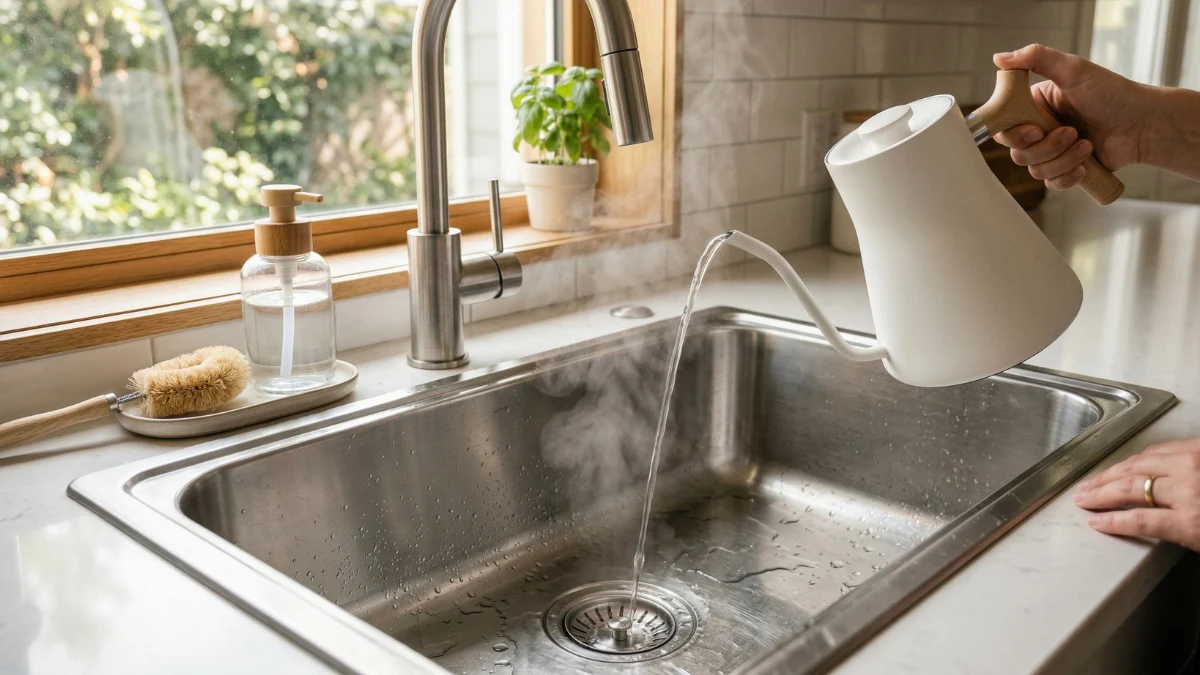
- The Boiling Water and Dish Soap Method: Boil a large kettle of water. Squirt a generous amount of a premium grease-fighting dish soap directly into the drain. The soap acts as a surfactant, immediately binding to the grease. Slowly pour the boiling water down the drain in stages. Giving the hot water time to melt the congealed fat and the soap time to wash it away is highly effective.
- The Trusty Plunger: If the sink is completely backed up and water is pooling, a standard cup plunger is your best friend. Ensure there is enough water in the sink to cover the bell of the plunger, block the overflow hole with a wet cloth to ensure a tight vacuum, and plunge vigorously. The physical suction pushes and pulls the water, which is infinitely more powerful than any chemical fizz.
For Bathroom Sinks and Tubs (Hair and Soap Scum)
Bathroom clogs are a totally different beast. They are primarily constructed of long human hair bound tightly together by sticky body wash and soap scum. Neither boiling water nor dish soap will dissolve a thick mat of hair.
- The Plastic Drain Snake (Zip-It Tool): This is the ultimate, affordable weapon against bathroom clogs. It is a long, flexible piece of plastic equipped with backward-facing barbs. You slide it down the drain, twist, and pull. The barbs hook onto the hair clump and physically drag it out of the pipe. It is definitely not glamorous, but it is unequivocally effective.
- Enzymatic Drain Cleaners: For a biological, preventative approach, look for high-quality enzymatic cleaners. These contain natural bacteria that literally digest the organic matter (like hair, skin cells, and soap) over time. They work slowly—often needing to sit overnight—but they are entirely safe for your pipes and the broader environment.
When to Put Down the Tools and Call a Professional
There is a distinct line between a simple home maintenance task and a complex plumbing emergency. If you have tried the boiling water, the dish soap, thorough plunging, and a manual plastic snake, and the water still refuses to budge, it is time to step back. Similarly, if multiple drains in your home are backing up simultaneously, or if water is coming up into your bathtub when you flush the toilet, you are dealing with a main sewer line issue.
In these severe scenarios, pouring anything down the drain is completely futile. Professional plumbers in 2026 have access to motorized augers, high-pressure hydro-jetting equipment, and fiber-optic cameras to accurately diagnose and eliminate severe blockages. Attempting to force a stubborn, deep clog with harsh, store-bought industrial chemicals often leads to permanently damaged pipes and much more expensive repair bills down the road.
Preventative Drain Care: Stopping the Problem Before It Starts
The absolute best way to handle a clogged drain is to prevent it from forming in the first place. Adopting a few simple daily habits will keep your pipes flowing freely for years.
First, invest in high-quality drain catchers for every single sink and shower in your home. These inexpensive stainless steel mesh or silicone screens catch food debris and stray hairs before they ever enter the plumbing system. Make it a daily habit to empty them.
Second, fundamentally change how you handle kitchen grease. Never, under any circumstances, pour liquid cooking oil or heavy animal fats down the sink. Even if you run it with scorching hot water, the fat will eventually cool, solidify, and coat the interior walls of your pipes like plaque in an artery. Instead, let grease cool and solidify in a disposable container, or wipe greasy pans thoroughly with paper towels before washing them in the sink.
Finally, institute a simple weekly maintenance routine. Once a week, pour a full kettle of boiling water down your kitchen and bathroom sinks. This regular thermal flush helps melt away minor accumulations of soap scum and grease before they have a chance to build into a formidable blockage.
Final Thoughts
It is incredibly easy to see why the baking soda and vinegar hack became so wildly popular. It is inexpensive, uses perfectly safe household items, and provides an incredibly satisfying visual display that makes you feel productive. However, when it comes to practical home maintenance, we have to follow the science. The chemical reality is that mixing an acid and a base simply leaves you with inert, salty water that does nothing for your pipes.
By understanding how your plumbing actually works and utilizing the right tools for the job—whether that is a grease-cutting detergent, a simple plunger, or a plastic drain snake—you can tackle slow drains effectively and safely. Save the baking soda for deodorizing your refrigerator, save the vinegar for polishing your windows, and leave the drain clearing to practical methods that actually get the job done.