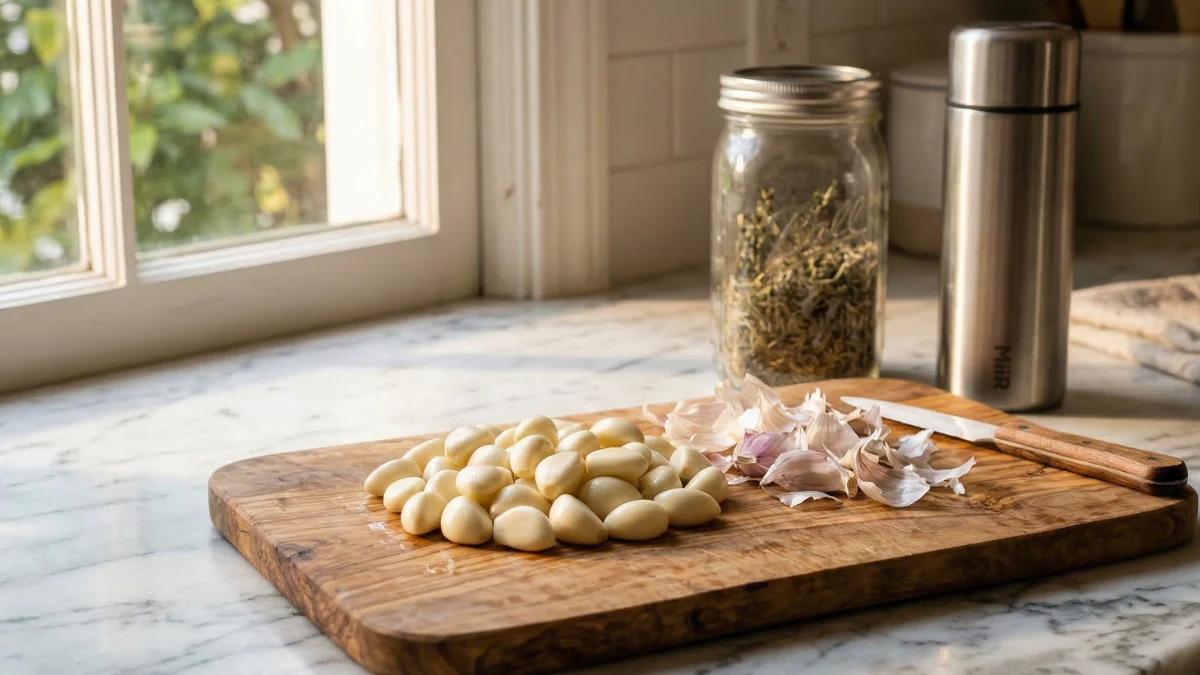
Welcome to the kitchen! Grab a warm cup of coffee, settle into a comfortable spot, and let us talk about a culinary ingredient that is as universally loved as it is notoriously annoying to prepare: garlic. Whether whipping up a rich Sunday pasta sauce, a vibrant salsa, or a comforting roast chicken, garlic is the absolute flavor foundation. But before anyone can enjoy that aromatic depth, they have to get past the gatekeeper—the papery, sticky, frustrating peel.
Every home cook knows the struggle. The cloves stick to fingers, the thin skins cling to the cutting board, and hands carry that unmistakable pungent scent for the rest of the day. It is no wonder that whenever a new peeling shortcut appears online, it spreads like wildfire. Among the most famous of these viral techniques is the “Two-Plate Shake” (also commonly done with two bowls). Promoted by celebrity chefs on platforms like YouTube and endlessly debated by home cooks across social media, this technique promises to strip the skins off an entire bulb of garlic in mere seconds.
But does this highly publicized trick actually hold up in a real, everyday kitchen? Let us peel back the layers of this internet sensation, exploring the exact steps, the food science behind it, and what real cooking communities have to say about its practicality.
The Anatomy of the Two-Plate Shake
The premise of this technique is delightfully simple. It requires no special gadgets, no intricate knife skills, and absolutely zero tedious picking at tiny skins. Here is the classic breakdown of how the method is traditionally taught:
Step 1: The Initial Smash First, separate the whole garlic bulb into individual cloves. Place the entire bulb on a sturdy cutting board, root side down. Place the heel of your hand firmly on top of the stem and push down hard. You will hear a satisfying crunch as the bulb shatters into its individual cloves. Discard the main central stem and any loose, papery outer layers.
Step 2: The Setup Gather all the unpeeled cloves and place them on a standard, hard dinner plate (or inside a large mixing bowl). Take a second identical plate and place it upside down over the first one, forming a closed, flying-saucer shape. If using bowls, place them rim-to-rim to form a sealed sphere.
Step 3: The Shake This is where the physical effort comes into play. Grip the edges of both plates firmly with both hands, ensuring they are tightly sealed so nothing escapes. Now, shake them vigorously up and down, and side to side. You want the cloves to rattle forcefully against the hard surfaces and against each other. Continue this aggressive shaking for about ten to twenty seconds.
Step 4: The Reveal Remove the top plate. If the conditions were right, you should be looking at a pile of completely naked, smooth garlic cloves resting among a pile of empty, discarded skins. Simply pluck out the pristine cloves and proceed with the recipe.
The Logic Behind the Technique
Why does this violently energetic approach work? It all comes down to friction, impact, and the natural anatomy of the garlic clove. By trapping the cloves in an enclosed hard space and subjecting them to rapid movement, the process essentially mimics an industrial tumbling machine.
The cloves repeatedly smash against the rigid ceramic or metal walls of the containers. This blunt force fractures the dry outer skins. Simultaneously, the cloves bump and grind against one another, producing intense friction that grabs and pulls the already loosened skins away from the sticky flesh of the garlic. In a perfectly controlled scenario, this combination of impact and friction handles all the tedious manual labor.
Real Talk: What the Culinary Community is Actually Saying
While a flawlessly executed video might make this look effortless, the reality in home kitchens is often a bit more nuanced. A deep dive into active culinary communities, particularly forums like Reddit’s r/Cooking and r/LifeProTips, reveals a highly divided audience. Real cooks sharing their unfiltered experiences highlight several crucial factors that determine whether this hack is a brilliant timesaver or a frustrating disaster.
The Noise Factor One of the most frequent comments from those who have tried this with metal mixing bowls is the sheer volume of the process. As one vivid reviewer on Reddit described it, shaking hard garlic cloves vigorously inside two stainless steel bowls sounds “like being trapped inside a steel drum during a Texas-caliber hail storm.” If prepping a quiet morning meal or working while family members are sleeping nearby, this is definitely not the method to choose.
The “Flying Garlic” Hazard Using two dinner plates, as the name of the hack suggests, requires an iron grip. Many home cooks report that during the intense shaking, their hands slipped, the plates separated by a fraction of an inch, and sticky garlic cloves went flying across the kitchen floor. Because flat plates do not have deep interlocking rims, they are incredibly prone to slipping under vigorous movement.
The Freshness Variable This is perhaps the most critical insight from the community. The success of this technique relies entirely on the moisture level of the garlic. If using older garlic that has been sitting in the pantry for a few weeks, the skin is dry, brittle, and slightly separated from the clove; it will shatter and fall off beautifully during a shake. However, if the garlic is incredibly fresh and juicy, the skin will cling to the flesh with a stubborn stickiness. As many frustrated cooks have noted, you can shake fresh garlic until your arms are sore, and the skins will absolutely refuse to budge.
Upgrading the Hack: Smarter Tools for Better Results
To harness the power of this technique without the drawbacks, the culinary community has developed some brilliant modifications. The general consensus is clear: ditch the two dinner plates.
Instead of precarious plates or deafening metal bowls, try using a sturdy metal thermos, a large glass mason jar, or a heavy Pyrex container with a locking plastic lid.
A metal thermos provides the perfect hard interior to break the skins but is designed to be gripped securely in one hand, eliminating the risk of a kitchen explosion. A large glass jar with a tightly screwed-on lid works similarly well. The key is ensuring the container is large enough; the cloves need plenty of empty space to fly around and gain momentum. If crammed into a tiny plastic container, they will simply jostle against each other without generating enough force to break the skins.
Pro-Tip: Before tossing the cloves into the thermos or jar, use a sharp knife to quickly slice off the tough, woody root end of each clove. This severs the skin’s strongest anchor point, allowing it to slip off much easier during the tumbling process.
When to Use This Technique (And When to Skip It)
Context is everything in the kitchen. This vigorous shaking method is not a one-size-fits-all solution.
When it shines: Reserve this technique for high-volume cooking. When preparing a classic Forty-Clove Chicken, roasting whole heads of garlic for a creamy mashed potato dish, or preserving jars of homemade garlic confit, this hack is a genuine lifesaver. When a recipe demands twenty or thirty cloves perfectly whole and unblemished, the time saved by shaking a large batch far outweighs the effort and the extra dishes to wash.
When to skip it: If a recipe only calls for one or two cloves of minced garlic, taking out two large bowls or a heavy thermos is entirely counterproductive. The ten seconds it takes to shake the garlic is immediately offset by the two minutes spent washing and drying the bulky containers. For small jobs, manual methods remain the undisputed champions.
Alternative Methods for the Everyday Cook
If the shaking method sounds like too much of a workout, or if only a small amount of garlic is needed, there are other community-approved, highly effective techniques to keep in the culinary repertoire:
- The Classic Knife Smash: This is the industry standard for a reason. Place a single unpeeled clove on the cutting board, lay the flat, broad side of a chef’s knife over it, and give the blade a firm, careful smack with the heel of the hand. The clove will lightly crush, instantly breaking the skin, which can then be peeled away in one smooth motion. This is perfect for mincing, as it jumpstarts the crushing process.
- The Warm Water or Microwave Shortcut: If whole cloves are required but the stickiness is unbearable, food science offers a gentle shortcut. Place the cloves in a small bowl of warm water for a few minutes, or microwave them on a very low setting for about ten to fifteen seconds. The slight heat generates steam between the clove and the papery layer, loosening the skin so it slips off effortlessly.
- The Silicone Roller: For those who prefer a dedicated tool, a simple silicone garlic peeling tube is highly rated. Place a clove inside the hollow tube, press down lightly, and roll it back and forth on the counter. The grippy silicone catches the dry skin and tears it away while leaving the clove perfectly intact.
Final Thoughts
The kitchen is a place for continuous learning, efficiency, and finding what works best for an individual cooking style. The “Two-Plate Shake” is far from a mere internet myth; it is a genuinely effective technique grounded in practical friction and impact. However, it requires the right tools, the right type of dry garlic, and a recipe that justifies the effort.
Next time a mountain of unpeeled garlic is sitting on the cutting board, grab a sturdy jar, channel some energy, and give it a vigorous shake. It might just become the new favorite kitchen shortcut. Happy cooking, and may every meal be perfectly seasoned!